
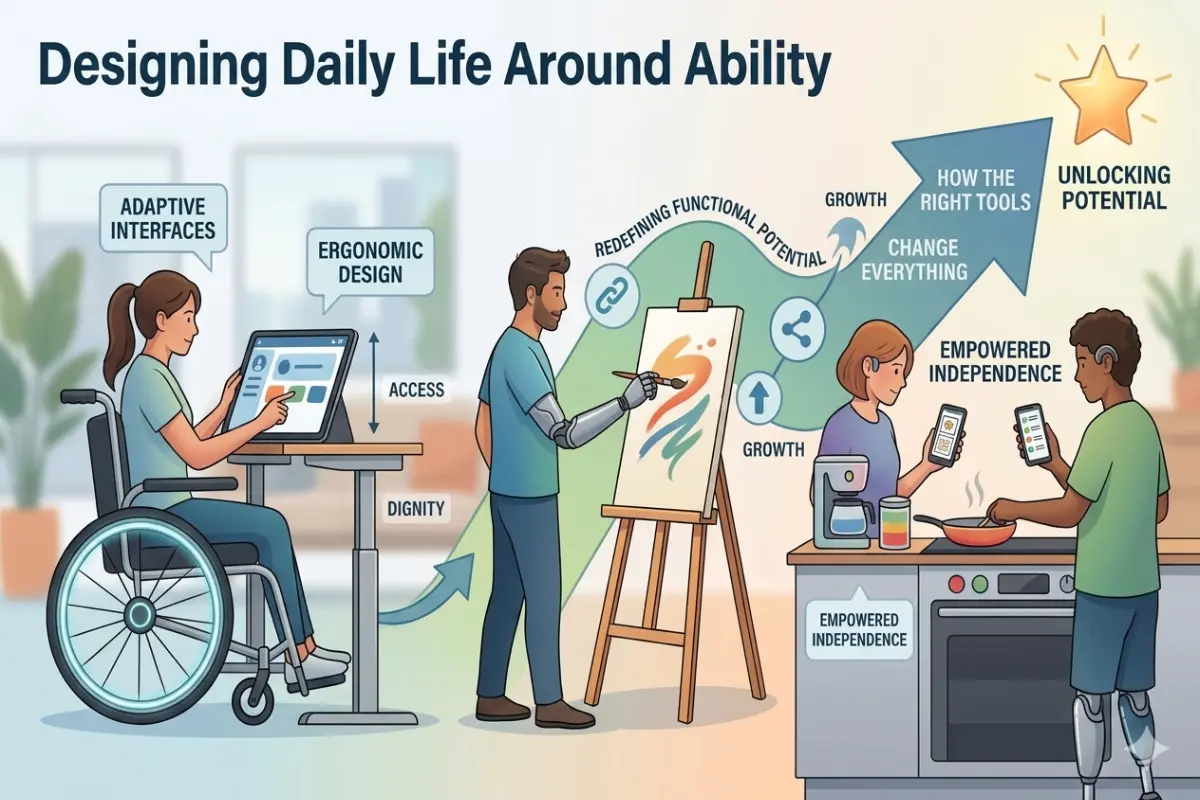
Daily life is often designed with a set of assumptions about what people can do, how they move, communicate, and interact with their environment. But for individuals with disabilities or differing abilities, these assumptions can create barriers that go far beyond inconvenience. Forward-thinking caregivers, clinicians, and families are shifting away from a deficit-based mindset and instead focusing on ability-centered design. The result is a powerful transformation: daily routines that feel more natural, more independent, and far more empowering.
Designing life around ability isn’t just about convenience. It’s about access, dignity, and unlocking potential. With the right tools in place, ordinary activities become opportunities for growth, confidence, and participation.
What Does “Normal” Mean in Daily Living for People with Disabilities?
For decades, the goal in many care settings was to help individuals “fit into” a standard version of daily life. This often meant adapting the person rather than adapting the environment. Today, that philosophy is changing.
Ability-centered design starts with a simple question: What can this person do, and how can we build around that? Instead of focusing on limitations, it highlights strengths and looks for ways to support them. This shift leads to more personalized solutions that make everyday activities, from getting dressed to participating in school, more accessible and meaningful.
It also challenges the idea that independence must look a certain way. For one person, independence might mean walking unassisted. For another, it might mean using adaptive tools to complete the same task differently. Both outcomes are equally valid.
How Do Assistive Tools Support Independence in Everyday Life?
Assistive tools play a central role in bridging the gap between ability and environment. These tools range from simple modifications, like ergonomic utensils or grab bars, to more advanced equipment designed for mobility, communication, or posture support.
What makes these tools transformative is not just their functionality, but how they integrate into daily routines. When chosen correctly, they reduce frustration, conserve energy, and allow individuals to participate more fully in activities that matter to them.
For example, adaptive seating can improve posture and engagement during meals or classroom activities. Mobility aids can open up access to spaces that might otherwise feel limiting. Communication devices can give a voice to someone who struggles with speech. Each tool becomes part of a broader system that supports autonomy.
The key is thoughtful selection. Tools should align with the individual’s goals and comfort level, not just clinical recommendations.
When Assistive Tools Actually Backfire, And Why No One Talks About It
Most conversations about assistive technology stay focused on the benefits. And the benefits are real. But experienced practitioners know something that rarely makes it into blog posts or brochures: the wrong tool, introduced at the wrong time, can slow progress instead of supporting it.
This isn’t a reason to avoid assistive equipment. It’s a reason to choose it carefully.
Prompt dependency is a real clinical concern. When a child is introduced to a mobility device before they’ve had the opportunity to develop functional movement patterns they’re capable of achieving, the device can reduce their motivation to build those skills independently. Pediatric physical therapists see this regularly, it’s not a failure of the equipment, it’s a timing and assessment problem.
Overly supportive seating can work against core development. A positioning system that does too much of the postural work for the user can gradually reduce muscle engagement. Over time, this creates a dependency that may complicate long-term rehabilitation goals. The right level of support depends on where the individual is in their development, and that changes.
Abandonment rates are higher than most people realize. Studies consistently show that anywhere from 30 to 50 percent of assistive devices are eventually abandoned by users. The most common reasons are poor fit, social stigma, and equipment that’s too complex to use consistently. Any approach to tool selection that doesn’t take abandonment risk seriously is missing half the picture.
The caregiver convenience trap is subtle but significant. In some care settings, particularly institutional ones, equipment gets selected based on how easy it is for caregivers to manage, not how well it serves the user. These decisions are rarely made with bad intent, but the outcome can be a tool that works for everyone except the person it’s meant to help.
Upgrading equipment isn’t always progress. For individuals with autism, sensory processing differences, or strong attachment to routine, switching to a “better” device mid-routine can cause significant behavioral regression, even when the new tool is clinically superior. The disruption itself becomes the barrier.
The takeaway isn’t that assistive tools are risky. It’s that thoughtful selection, proper timing, and honest ongoing evaluation matter far more than most people are told upfront.
How Do Assistive Tools Support Child Development for Kids with Disabilities?
In pediatric settings, the impact of ability-based design is especially profound. Children are constantly learning and growing, and their environments play a crucial role in shaping development.
When the right tools are introduced early, they can support not just physical abilities but also cognitive and social growth. For instance, positioning devices can help children engage more effectively with their surroundings, improving their ability to interact, learn, and play.
A well-fitted pediatric stander can allow a child who cannot stand independently to experience an upright position. This doesn’t just benefit physical development; it can also change how the child interacts with peers, participates in activities, and perceives their own capabilities.
The goal is not to force milestones, but to provide opportunities. By giving children access to experiences they might otherwise miss, these tools help build a stronger foundation for lifelong skills.
Why Sensory Profiles Must Drive Tool Selection Before Anything Else
There’s a variable that shapes how every piece of assistive equipment is received, and it’s one of the most underweighted factors in standard assessment protocols. That variable is sensory processing.
Before asking what a tool can do, it’s worth asking: how will this person’s nervous system respond to it?
Tactile defensiveness explains more equipment rejections than behavior does. A child who refuses to wear a supportive harness, sit in an adaptive chair, or use a communication device is often described as non-compliant. But in many of these cases, what’s actually happening is sensory avoidance, the texture, pressure, or material of the equipment is genuinely aversive. Without a sensory lens, the problem gets misread, and the intervention keeps failing.
Proprioceptive seekers need equipment that pushes back. Children and adults who crave deep pressure or resistance often engage far better with equipment that offers compression or firm resistance than with standard alternatives. Standard assessment protocols don’t always capture this unless a sensory processing screen is explicitly included. It’s a gap worth closing.
Sound matters more than most tech-based tools account for. Communication devices, tablets, and powered equipment all produce sound, alerts, synthesized voices, motor noise. For individuals with auditory hypersensitivity, this isn’t a minor inconvenience. It can drive outright rejection of a device that would otherwise be genuinely useful. Volume control and sound profile customization should be evaluated before any tech-based tool is selected.
Vestibular processing differences affect how mobility equipment feels. Some individuals experience disorientation, anxiety, or nausea in power wheelchairs and dynamic seating systems, not because they’re afraid of the equipment, but because their vestibular system is processing movement differently. This is consistently underreported and frequently misattributed to fear or adjustment resistance.
Sensory-hostile environments undermine even the best tools. Harsh lighting, high ambient noise, and unpredictable spatial layouts create a sensory load that competes directly with any tool’s effectiveness. A well-calibrated communication device used in a chaotic, overstimulating classroom will underperform, not because of anything wrong with the device, but because the environment is working against it.
Sensory profiling isn’t an optional add-on to the assessment process. It’s the foundation that determines whether any tool has a realistic chance of working in the real world.
How Should Home and School Environments Be Designed to Support Assistive Tools?
Assistive tools are most effective when they are part of a larger, cohesive environment. A single device can only do so much if the surrounding space isn’t designed to support it.
This means considering the entire ecosystem of daily life: home layouts, school classrooms, transportation, and community spaces. Small adjustments, like widening doorways, lowering counters, or improving lighting, can make a significant difference.
Coordination is also essential. Caregivers, therapists, and educators should work together to ensure consistency across environments. When tools and strategies are aligned, individuals can move between settings with greater ease and confidence.
This kind of integrated design reduces the need for constant adaptation and allows daily routines to flow more naturally.
What Is the Emotional and Social Impact of Ability-Centered Design?
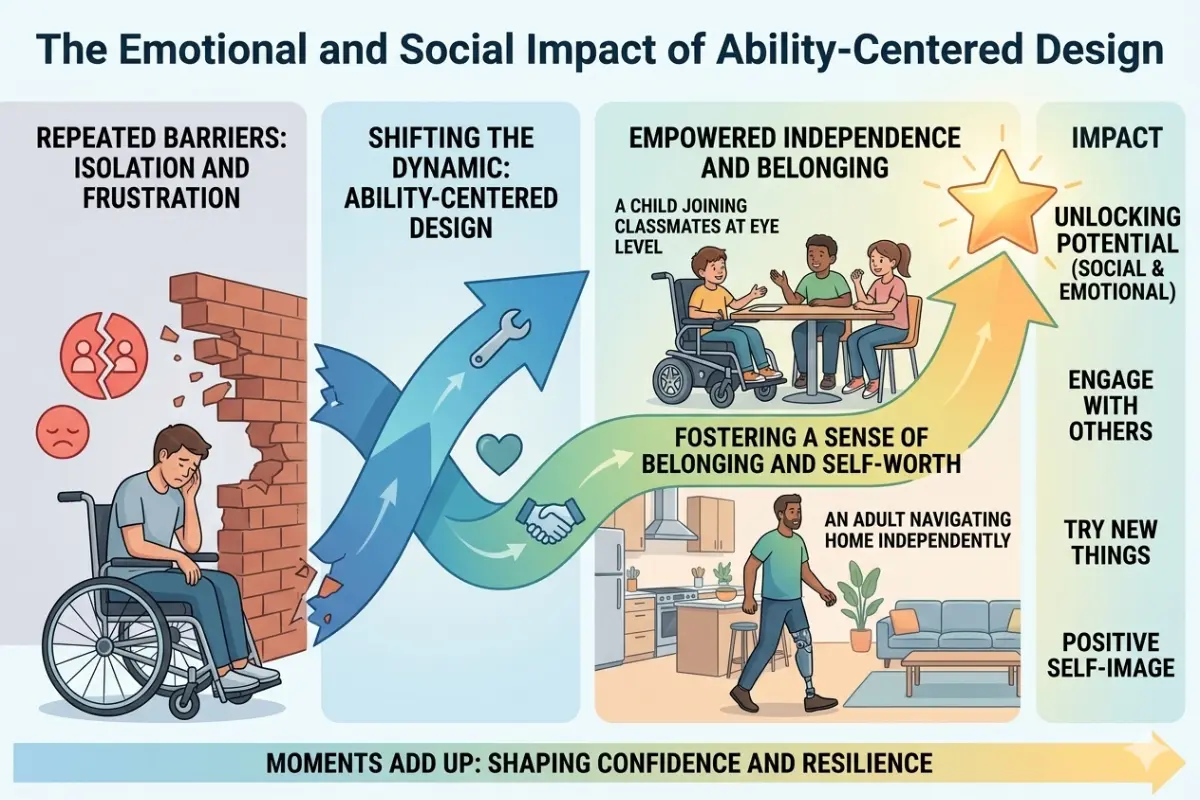
While the physical benefits of assistive tools are often the most visible, the emotional and social impact can be just as significant. Being able to participate in everyday activities fosters a sense of belonging and self-worth.
When individuals feel included, they are more likely to engage with others, try new things, and develop a positive self-image. Conversely, repeated barriers can lead to frustration, isolation, and decreased motivation. According to research on aging independence through environmental design published by the National Institutes of Health, a person’s daily functioning is heavily dictated by how well their physical surroundings adapt to their unique abilities.
Ability-centered design helps shift this dynamic. Removing obstacles and enabling participation, it creates opportunities for meaningful connections. A child who can join classmates at eye level, or an adult who can navigate their home independently, experiences a level of empowerment that extends beyond the task itself.
These moments add up, shaping confidence and resilience over time.
Myths That Shape, and Limit, Real-World Outcomes
Some of the assumptions driving decisions in this space have been around long enough that they feel like facts. They aren’t. Here are five that experienced practitioners regularly push back on.
| Myth | Reality |
|---|---|
| More independence is always the goal | Independence without safety, sustainability, or personal meaning is a clinical success and a human one only on paper. Some individuals genuinely prefer supported participation, and that is a valid, self-determined choice, not a failure of the intervention. |
| Universal design covers everyone | Universal design removes barriers for the majority. It frequently leaves individuals with complex or multiple disabilities underserved, because their needs don’t fit the majority-use model the design was built around. |
| Giving a child a communication device will stop them from trying to talk | This is one of the most persistently harmful myths in AAC. Research consistently shows that providing augmentative communication tools increases natural speech attempts rather than replacing them. Withholding devices out of this concern causes measurable harm. |
| More advanced technology means better outcomes | Low-tech solutions, adapted grips, foam tubing, visual schedules, and weighted utensils, frequently outperform expensive technology in daily carryover. They don’t need charging, they don’t break down, and they’re available in every environment. Complexity is not the same as effectiveness. |
| Adapting means the person couldn’t meet the standard | This is the deficit model repackaged. Adaptation is a correction to the environment, not a commentary on the individual. The standard was designed around assumptions that don’t apply to everyone, the adaptation fixes that design problem. |
Clearing out these assumptions creates space for decisions based on what actually works, rather than what sounds reasonable in theory.
Real-World Examples of Ability-Centered Tools in Action
To understand how ability-centered design transforms lives, we can look at the everyday tools and software bridging the gap between physical limitations and empowered independence:
- Adaptive Interfaces & Digital Tools: Screen magnifiers, speech-to-text dictation tools, high-contrast themes, and specialized eye-tracking software vetted by the Assistive Technology Industry Association (ATIA) allow individuals with limited mobility or visual impairments to navigate computers and tablets effortlessly.
- Smart Home Ecosystems: Voice-activated assistants (such as Amazon Alexa or Google Assistant), automated smart lighting, and remote-controlled thermostats allow users to manage their entire environment without physical switches.
- Ergonomic & Adaptive Kitchenware: Automatic pan stabilizers, one-handed cutting boards, weighted utensils for tremors, and magnetic clothing fasteners turn potentially frustrating daily routines into safe, stress-free tasks.
- Advanced Mobility Solutions: Custom-fitted bionic prosthetics, motorized standing wheelchairs that allow users to converse at eye level, and zero-threshold home entryways eliminate physical boundaries.
How to Implement Ability-Centered Design at Home
Bringing inclusive design into your daily life doesn’t always require a major renovation. You can start making your space more functional with a few practical steps:
- Audit Your Daily Friction Points: Notice where you or your loved ones experience daily frustration or fatigue. Is it reaching a high shelf, turning a stiff doorknob, or viewing a dim screen? Target those specific spots first.
- Swap Out Traditional Hardware: Replacing standard round doorknobs with lever handles and installing pull-out cabinet organizers can instantly make a home kitchen or bathroom dramatically more accessible.
- Leverage Built-In Device Accessibility: Before buying expensive software, explore the deep accessibility menus already built into your smartphones, computers, and smart TVs. Features like voice control, text-to-speech, and haptic feedback are completely free and highly advanced.
- Explore Community Assistive Technology Programs: If you need specialized hardware or mobility aids, look into local non-profits, vocational rehabilitation programs, or state-funded programs through the national network of the Association of Assistive Technology Act Programs that offer excellent device loan libraries and financial guidance.
How Should Assistive Tools and Strategies Adapt as a Person’s Needs Change?
One of the most important aspects of designing daily life around ability is recognizing that needs evolve. What works today may not work tomorrow, especially for growing children or individuals with progressive conditions.
This requires ongoing assessment and flexibility. Tools should be adjustable, adaptable, or replaceable as circumstances change. Regular input from healthcare professionals, along with feedback from the individual and their caregivers, ensures that solutions remain effective.
It’s also important to balance stability with innovation. While new technologies can offer exciting possibilities, consistency in daily routines provides comfort and predictability. The goal is to introduce changes thoughtfully, without disrupting what already works well.
(Advanced): Building a Cross-Environment Consistency Protocol
This section is written for practitioners, program directors, and experienced caregivers already managing complex, multi-setting cases. If you’re earlier in the process, the sections above will be more immediately applicable.
The most common point of failure in assistive technology isn’t selection. It’s implementation, specifically, the gap between a tool that works in therapy and a tool that works consistently across a person’s entire daily life.
Closing that gap requires treating implementation as its own discipline.
The therapy bubble is the single most common implementation failure. A skill or tool use pattern that’s been carefully developed in a structured clinical setting frequently doesn’t transfer, not because the intervention failed, but because no carryover system exists outside that setting. The tool worked. The ecosystem around it didn’t. Recognizing this as a systems problem (not a patient problem) is the first step toward solving it.
High-performing care teams build environment-specific tool maps. This goes beyond documentation of what equipment is in use. It specifies where each tool is used, when, how, and by whom, with contextual triggers, caregiver-specific notes, and troubleshooting guidance for each setting. A tool map for home looks different from one for school, which looks different from one for a community outing. The goal is that any person supporting the individual in any setting has a clear, context-specific reference, not a generic instruction sheet.
Stakeholder alignment requires a shared goal narrative. Therapists, teachers, and caregivers often apply the same tool inconsistently because each has a slightly different mental model of what it’s for. Creating a plain-language “goal narrative”, a one-paragraph description of what the tool is meant to accomplish and what success looks like in practice, dramatically improves consistency across environments. It sounds simple. It’s rarely done.
Drift is inevitable without a structured review. Over months, caregiver technique drifts, equipment gets informally modified, positioning gets adjusted “just slightly,” and the original protocol becomes unrecognizable. This isn’t negligence, it’s human. High-performing teams build quarterly review checkpoints specifically to detect and correct drift before it compounds into a problem that requires starting over.
Handoff moments are where systems collapse. Transitions between care settings, early intervention to school-age services, pediatric to adult services, one school district to another, are where carefully built systems most often fall apart. The diagnostic history travels. The tool context, sensory notes, and hard-won implementation knowledge usually don’t. Advanced practitioners build handoff documentation designed to travel with the individual: not just what tools are in use, but why they were chosen, what’s been tried and failed, and what must not change during the transition period.
Implementation is a craft. The practitioners who do it well don’t just know the right tools, they know how to build the systems that keep those tools working across every environment, every caregiver, and every transition in a person’s life.
Frequently Asked Questions
Can Assistive Tools Actually Slow Down a Child’s Development?
Yes, in specific circumstances, and this is a concern that experienced pediatric therapists take seriously. When equipment is introduced before a child has had the opportunity to develop functional movement or communication patterns they’re capable of achieving independently, it can reduce motivation to build those skills. This isn’t an argument against assistive tools; it’s an argument for careful timing, ongoing assessment, and selecting tools that support development rather than substitute for it. The goal is always to match the right tool to the right moment in the child’s developmental trajectory.
Why Do so Many People Abandon their Assistive Devices?
Research consistently places assistive device abandonment rates between 30 and 50 percent, with the most common reasons being poor fit, social stigma, and equipment that’s too complex to use reliably in daily life. A device that works well in a clinical setting often fails in the real world because the environment, the routine, or the caregiver support system wasn’t designed around it. Reducing abandonment requires selecting tools that fit the individual’s actual daily context, not just their clinical profile, and building genuine support systems around the device from day one.
Will Giving a Child an AAC Device Prevent Them from Learning to Speak?
This is one of the most persistent and consequential myths in the field of augmentative and alternative communication. The evidence points in the opposite direction: research consistently shows that providing AAC devices increases natural speech attempts rather than replacing them. Withholding communication tools out of fear of dependency has caused measurable harm to children who could have benefited from earlier access. If a speech-language pathologist recommends an AAC device, the concern about suppressing natural speech is not a clinically valid reason to delay.
What should Families Do When Insurance Denies a Prescribed Assistive Device?
The first and most important thing to understand is that a denial is not a final answer, it’s the beginning of an appeals process that families have a legal right to pursue. A significant proportion of denials are overturned when additional clinical documentation is submitted or when a peer-to-peer review is requested between the insurer and the prescribing clinician. Families should also ask their therapist to review the language in the original letter of medical necessity, since approval decisions often hinge on specific clinical framing rather than the underlying need.
How Do You Make Sure Assistive Tools are Used Consistently Across Home, School, and Community Settings?
Consistency across environments is one of the hardest implementation challenges in assistive technology, and it’s also one of the most important. The core problem is that each setting has different caregivers, different routines, and different understandings of what the tool is for. The most effective approach involves creating environment-specific guidance for each setting (not a single generic instruction sheet), developing a plain-language goal narrative that all caregivers share, and building in scheduled review checkpoints to catch and correct drift before it becomes entrenched. Transition planning, particularly during moves between service systems, should explicitly include tool context documentation, not just diagnostic history.
Key Takeaways: Designing Daily Life Around Ability
Designing daily life around ability is not a one-time adjustment; it’s an ongoing process rooted in empathy, observation, and creativity. By focusing on what individuals can do and providing the right tools to support those abilities, we move closer to a world where everyone can participate fully in everyday life.
The impact goes far beyond convenience. It touches confidence, independence, and quality of life in profound ways. Whether through a simple home modification or a specialized piece of equipment, the right tools can turn challenges into opportunities.
In the end, ability-centered design is about more than solving problems. It’s about creating environments where people can thrive, on their own terms, in their own way, every single day.
About The Author:
Beth Shamaiengar is a contributing editor at Health Journal. She holds a Bachelor’s degree in Journalism from the University of North Carolina at Chapel Hill and, before joining the Health Journal, became an award-winning writer and editor during 11 years with other publications. She also spent nearly a decade volunteering in PTA leadership roles in local schools, building her skills in marketing, event planning, project management, and communicating with a variety of audiences.
Medical disclaimer: This content is for informational purposes only and is not a substitute for professional medical advice.