

TL;DR: Maintaining your energy is the ultimate secret to longevity and aging well. True aging happens at a cellular level inside your mitochondria, but simple habits like morning light, protein timing, and polarized training can reverse chronic fatigue. Read this guide to understand how your body transforms over time. Then, tick our checklist at the end to see if your daily habits are building lasting cellular resilience.
In the high-stakes middle decades of life, roughly between thirty-five and sixty-five, most of us discover the same quiet truth: energy is our most volatile asset. We are no longer running on the reckless, boundless stamina of our twenties. We are operating on a more sophisticated, sensitive biological budget. To prioritize longevity is not merely to avoid disease. It is to maintain the metabolic flexibility required to stay as productive and engaged at fifty-five as we were at thirty.
What Is Really Driving Your Fatigue After 40?
Most age-related fatigue isn’t caused by aging itself. It’s caused by declining mitochondrial efficiency. Mitochondria are the organelles inside every cell that convert food and oxygen into usable energy (called ATP). When they lose efficiency with age, energy drops across every system in your body: your muscles, your brain, your immune response, and your hormonal regulation.
A December 2025 study published in ScienceDaily found that boosting a protein that helps mitochondria generate energy more efficiently extended both lifespan and healthspan in mice. The animals showed stronger metabolism, better endurance, and fewer signs of cellular aging. The conclusion was direct: improving cellular power output can slow the aging process itself.
In practical terms, this shows up as slower recovery from exercise, brain fog in the afternoon, and a mood that dips under pressure. These aren’t signs of weakness. They’re readouts of a cellular environment that needs attention.
The goal of longevity science isn’t to stop the clock. It’s to keep the machinery running well. Not a Fountain of Youth. A more efficient engine.
Is Inflammaging the Hidden Reason You Can’t Seem to Recover?
Inflammaging is a chronic, low-grade form of inflammation that builds with age in the absence of any infection or injury. It doesn’t feel like a flare-up. It feels like persistent, low-level exhaustion that survives better sleep, cleaner eating, and regular exercise, because none of those things target its root cause directly. It is now classified as a formal hallmark of aging and is measurable through a standard blood panel that most people never think to order.
According to ScienceDirect’s review of aging hallmarks, inflammaging sits alongside mitochondrial dysfunction as a bidirectional driver of cardiovascular disease, neurodegeneration, cancer, and frailty. It is not a side effect of aging. It is part of the mechanism.
The pathway that connects inflammaging to fatigue is cellular. Low-grade inflammation triggers a metabolic switch: the body moves away from efficient oxidative phosphorylation (the energy pathway your mitochondria use) and toward a less efficient glycolytic pathway. Less energy is produced. More oxidative stress builds up. Research published in Brain, Behavior & Immunity Health in December 2024 found a direct, measurable relationship between elevated inflammatory markers, including IL-6, CRP, and TNF-α, and both fatigue and pain in older adults. These markers rise gradually with age and cost you energy every single day.
The five root causes are worth knowing: ultra-processed food, chronic psychological stress, poor sleep quality, gut microbiome imbalance, and a sedentary baseline. I’ve noticed that when people address even two or three of these simultaneously, the change in daily energy is noticeable within two to four weeks. There’s no supplement stack that addresses all five at once, which is why no supplement stack solves this problem on its own. You can learn more about the gut’s specific role in this cycle by reading about the gut health and inflammation connection.
Pay attention if your fatigue has improved with better sleep, cleaner eating, and regular exercise. Inflammaging may be the missing variable. If you’ve been noticing signs your body needs a reset, low-grade inflammation is often the reason they’re persisting.
How Light, Cortisol, and Melatonin Control Your Daily Energy Budget
Your energy across any given day is not just a product of sleep quantity. It’s a product of hormonal timing.
Cortisol and melatonin follow an almost opposite 24-hour rhythm. Cortisol peaks within 30 to 45 minutes of waking, providing natural alertness to start the day. It declines through the afternoon, reaching its lowest point around bedtime, which allows melatonin to rise and promote sleep. That rhythm, when intact, is your natural energy system.
The problem is that with aging, melatonin production declines and shifts later, while cortisol tends to peak earlier in the night. The two hormones drift out of phase. The result is poor sleep architecture, slower morning recovery, and a hormonal mismatch that no quantity of sleep fully repairs.
Artificial light compounds the problem. Research on circadian disruption consistently shows that chronic stress and evening screen exposure keep cortisol elevated into the night, blocking melatonin production. You end up wired but tired. That pattern is not a personality type. It’s a hormonal one.
The fix is structural, not supplemental. Getting bright light into your eyes within 30 minutes of waking anchors cortisol at the right hour. Dimming screens and switching to warm lighting at least two hours before bed allows melatonin to rise on schedule. Building these morning habits for energy doesn’t cost anything. It doesn’t require a device. And it works at the hormonal level, not the symptomatic one.
Pairing this with better sleep and brain recovery at night reinforces the full cycle and compounds the benefit over weeks.
What the Longevity Industry Gets Wrong About Energy: Myth vs. Reality
Most energy and aging advice is built on misattributed causation. Here are four of the most persistent myths, and what the evidence actually shows.
Myth: More sleep fixes low energy. Sleep duration is far less important than sleep timing and quality. Staying up late to “get more done” while fighting a morning chronotype creates a cortisol mismatch that no quantity of sleep fully repairs.
Myth: Zone 2 cardio is all you need. Zone 2 builds aerobic base and metabolic resilience, but VO2 max, the single most powerful predictor of all-cause longevity, responds most efficiently to high-intensity work. You need both, not one or the other.
Myth: Fatigue means you need more rest. Resting into chronic low-grade inflammation without addressing the cellular environment just delays the reckoning. Sometimes the right answer to exhaustion is structured movement, not a rest day.
Myth: A supplement stack compensates for structural lifestyle gaps. No NMN dose offsets five consecutive nights of five-hour sleep combined with daily cortisol surges. Supplements are fine-tuning tools. They are not foundations.
The Movement Prescription: What Your Mitochondria Actually Need
In younger years, exercise is often about intensity or appearance. As we age, it becomes a biological necessity. Exercise programs for healthy aging all share one mechanism: they stimulate mitochondrial biogenesis, the process of generating new, healthy mitochondria to replace the ones that have degraded.
Zone 2 training (steady aerobic effort where you can hold a conversation) has received enormous attention in the longevity space. The evidence supporting it is real. Research from gethealthspan.com confirms that Zone 2 endurance training induces significant improvements in mitochondrial content, function, and substrate utilization, and that VO2 max is the single greatest predictor of all-cause longevity.
But a 2025 and 2026 review of the evidence added an important correction: Zone 2 works best as one component of a training program, not the only component. Higher-intensity work produces equal or greater mitochondrial adaptation when training volume is matched, and it’s the primary driver of VO2 max improvement.
The practical model is polarized training. Zone 2 builds the aerobic base and mitochondrial density. High-intensity intervals raise the aerobic ceiling by increasing maximal cardiac output and stroke volume. Think of Zone 2 as building a larger engine. Think of HIIT as tuning that engine to run faster. You need both.
For time-constrained adults: aim for 150 to 180 minutes per week of Zone 2 cardio, combined with one to two HIIT sessions that push heart rate to 90% of maximum for short bursts. Four minutes hard, four minutes recovery, four rounds. That is the minimum effective dose for meaningful mitochondrial adaptation in a professional schedule.
The “weekend warrior” pattern (five days sedentary, two days intense) is a recipe for inflammation, not longevity. Consistency throughout the week compounds over time.
How to Use HRV Trends as Your Personal Energy Dashboard
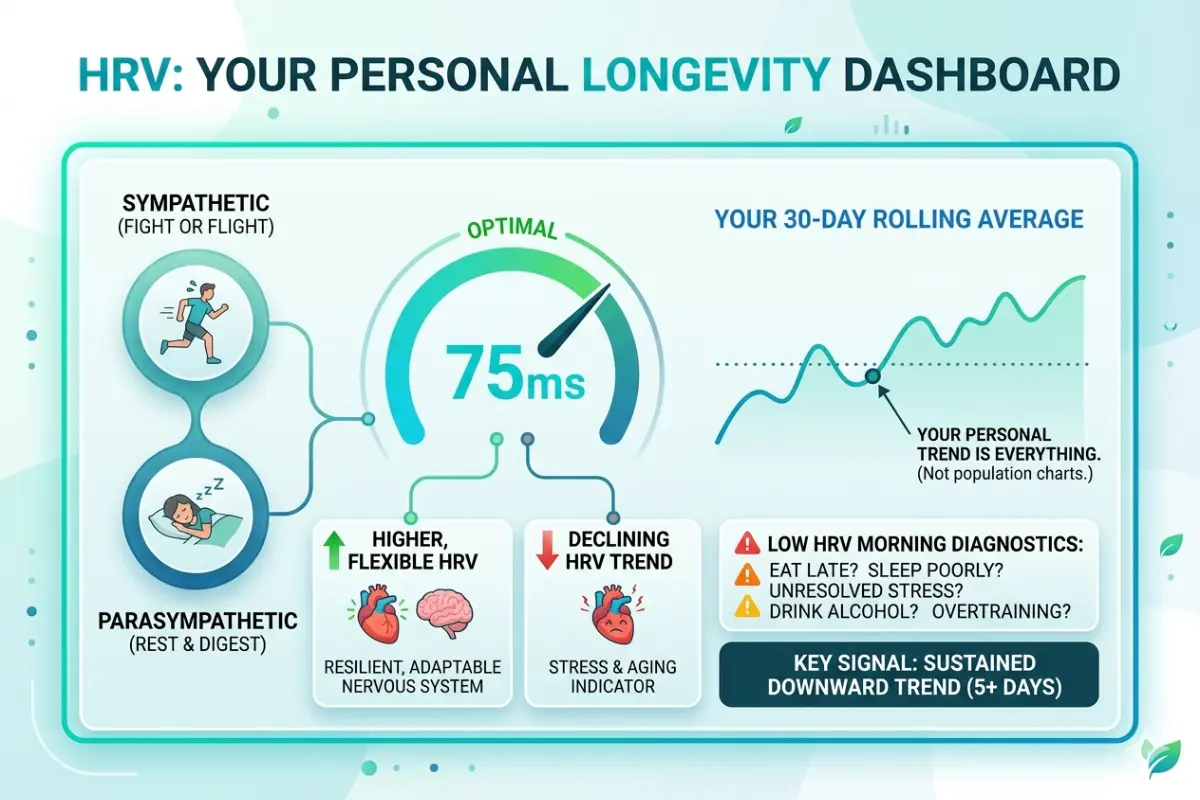
Heart rate variability (HRV) is the variation in time between consecutive heartbeats. It reflects the balance between your sympathetic nervous system (the “fight or flight” side) and your parasympathetic nervous system (the “rest and digest” side). A higher, more flexible HRV indicates a resilient, adaptable nervous system. A declining HRV trend over time indicates the opposite.
Research published in ScienceDirect found that HRV serves as a measurable biomarker of both aging and inflammaging, with persistently high HRV in older adults predictive of longevity. A study tracking centenarians found that people over 100 typically maintain higher HRV than age-matched controls, with autonomic flexibility appearing to contribute to exceptional longevity.
The practical implication most wearable guides miss entirely: the only meaningful benchmark for your HRV is your own 30-day rolling average. Population charts are nearly irrelevant. Your personal trend line is everything.
A low HRV morning is not automatically a reason to skip exercise. It’s a diagnostic question.
Did you eat late?
Sleep poorly?
Carry unresolved stress?
Drink alcohol?
Train too hard two days in a row? Each of these has a different corrective response. Treating all of them as “take it easy today” leaves the root cause unaddressed. A sustained downward trend over five or more days, not one bad morning, is the signal that warrants genuine recovery intervention.
What to Eat for Stable Energy and Mental Clarity After 50
After 50, the margin for nutritional error narrows significantly. In your 30s, you could fuel a demanding workday on adrenaline and simple carbohydrates and recover by the next morning. By your 50s, that same pattern produces brain fog and systemic lethargy by early afternoon. The shift isn’t about restriction. It’s about building a nutritional environment that keeps blood sugar stable, inflammation low, and cellular fuel consistent across the full day.
Blood sugar spikes aren’t just a metabolic concern. They’re an energy concern. Every glucose crash is a withdrawal from your cognitive bank account. Research confirmed that ultra-processed food intake is directly linked to accelerated epigenetic aging, independent of calories or BMI. The food debate has moved beyond weight. Food quality now appears to directly influence aging biology. And a 2025 review published in PMC confirmed that nutrition is a core factor in all five intrinsic capacity domains for healthy longevity: locomotion, vitality, cognition, psychological well-being, and sensory function.
Practical priorities for this stage of life: start each day with a minimum of 30 to 35 grams of protein to stabilize blood sugar and protect muscle. Build meals around slow-burning fuels: quality fats, fiber-rich plants, and clean proteins rather than refined carbohydrates that spike and crash. When I shifted away from reactive eating and toward a structured, protein-first meal, the afternoon cognitive output changed noticeably within two weeks. Not dramatically. Not instantly. But clearly and consistently.
Longevity-focused eating is less about following a specific diet label and more about building a nutritional environment that keeps your cells fueled, your inflammation low, and your blood sugar stable across every meal. For practical ways to support this, anti-inflammatory foods for recovery are a strong complement to a protein-first eating strategy.
The Polarized Training Model: An Expert Protocol for High-Performers Who’ve Outgrown Generic Fitness Advice
This section is not for beginners. It is for readers who already understand Zone 2, mitochondrial biogenesis, and recovery science, and who are ready for a structured protocol that actually scales with age.
The polarized training model is built on a simple but counterintuitive principle. Spending most training time at low intensity and a small amount at very high intensity, targeting both resting heart rate and VO2 max, is the most effective approach for long-term energy, cardiovascular health, and lifespan.
The mistake most self-directed exercisers make is defaulting to moderate intensity, effort that feels productive but is metabolically neutral. It is hard enough to accumulate physiological stress, never intense enough to trigger meaningful adaptation, and never easy enough to allow genuine aerobic recovery. It is the training equivalent of spinning your wheels.
The practical dose for time-constrained professionals: aim for 150–180 minutes per week of Zone 2 cardio combined with one to two HIIT sessions per week that push your heart rate to 90% of maximum for short bursts, four minutes of hard effort, four minutes of recovery, repeated four times. That is the minimum effective dose for meaningful mitochondrial adaptation in a professional schedule.
The professionals who report “working out consistently but still feeling exhausted” are almost always living entirely in the moderate-intensity gray zone. Polarized training solves this with structure, not more effort.
Practical Takeaways You Can Apply This Week
Anchor your circadian clock by seeking direct sunlight within thirty minutes of waking each morning.
Start your first meal with a minimum of thirty grams of protein to stabilize blood sugar and prevent the mid-morning energy collapse.
Add three minutes of focused nasal breathing between back-to-back meetings to lower cortisol and restore cognitive clarity.
Switch to warm, low-level lighting at least two hours before bed to signal your brain that the day’s demands are done.
And check your HRV trend, not just today’s number, to understand whether your current lifestyle is building resilience or draining it.
Healthy aging is an active choice, not a passive occurrence. You cannot control the calendar, but you can control the environment you provide for your cells. When you prioritize your energy, you are not just chasing a feeling. You are investing in your future capacity to contribute, create, and connect.
Your Energy and Longevity Checklist: Why Energy Is the Ultimate Marker of Aging Well
Use this to assess where you are and decide what to act on first.
Circadian Alignment
- I get natural bright light into my eyes within 30 minutes of waking most mornings
- I switch to warm, low-level lighting at least 2 hours before bed
- My sleep timing is consistent (within 30 minutes) most nights
Inflammation and Gut Health
- I eat ultra-processed food rarely (less than 10% of meals)
- I include fiber-rich plants in most meals
- I have an active strategy for managing chronic psychological stress
Movement and VO2 Max
- I accumulate 150+ minutes of Zone 2 cardio per week
- I include at least one high-intensity session (HIIT) per week
- I avoid sitting for more than 2 consecutive hours during the day
Protein and Muscle Protection
- My first meal of the day contains at least 30 to 35 grams of protein
- I include resistance training at least twice a week
- I track lean mass or grip strength periodically (not just body weight)
HRV and Recovery
- I track my HRV trend over 30 days, not just single readings
- When my HRV drops, I identify the specific cause before defaulting to rest
- I have a recovery protocol that goes beyond just sleeping more
Frequently Asked Questions
What Does Longevity Actually Mean in Practical Terms?
Longevity, in practical terms, means maintaining the physical and cognitive function to live well across all your decades, not just living longer. Researchers now distinguish between lifespan (total years lived) and healthspan (years lived in good health). A 2025 Nature Medicine study of nearly 45,000 people found that the biological age of your brain and immune system predicts healthspan better than chronological age. The goal is to keep those systems biologically younger through consistent, evidence-based lifestyle choices.
What is Inflammaging, and How Does It Affect Energy?
Inflammaging is a chronic, low-grade form of inflammation that develops with age in the absence of any obvious infection or injury. It’s associated with increased morbidity and mortality in the aging population, according to research published in ScienceDirect. At the cellular level, inflammaging triggers a metabolic switch that reduces efficient energy production and increases oxidative stress. The result is persistent fatigue that doesn’t respond to sleep, diet, or exercise changes alone, because none of those address the cellular environment directly.
Is Intermittent Fasting Safe After 45?
It can be, but the strategy needs to change. The core risk is sarcopenia, the age-related loss of muscle mass that accelerates when protein is insufficient, or fasting windows are pushed too long. A peer-reviewed paper on time-restricted eating and muscle loss highlights that older adults have reduced anabolic responsiveness, which makes protein timing within the eating window more important than the window length itself. If you fast past midday, track your lean mass, grip strength, and fasting glucose to make sure the practice is building resilience rather than depleting it.
What is the Best Exercise for Longevity?
A combination of Zone 2 aerobic training and high-intensity interval work delivers the strongest longevity outcome. Large cohort studies consistently show that VO2 max is the single greatest predictor of all-cause mortality reduction, and improving it requires both a strong aerobic base and regular high-intensity work. A practical weekly target is 150 to 180 minutes of Zone 2 effort combined with one to two HIIT sessions pushing to 90% of maximum heart rate. Consistency across the week matters more than intensity in any single session.
How Can I Measure My Biological Aging at Home?
Heart rate variability (HRV) is the most accessible at-home biomarker of biological aging. Most modern wearables track it automatically. What matters is your personal 30-day rolling average trend, not a comparison to population charts. Research on HRV and longevity shows that persistently high HRV in older adults predicts longevity, while a declining trend is linked to increased cardiovascular risk and reduced resilience. Grip strength is a second low-tech marker worth tracking monthly, as it correlates strongly with lean mass, functional capacity, and all-cause mortality risk.
About The Author:
Dr. Abid is a board-certified Internist and Geriatrician. Dr. Abid from a long tradition of a family of physicians. She graduated from the University of Health Sciences, Fatima Jinna Medical College in Pakistan. Completed her residency in Internal Medicine in Pittsburgh. Her keen interest in obtaining further in-depth training in managing complex diseases and cognitive disorders in elderly patients led her to pursue a geriatric Fellowship. After graduating, Dr. Abid served as a Geriatrician and Internist in Ohio for several years. She also held several leadership positions during her career, including medical directorship for Nursing homes and inpatient Geriatrics. She has published several articles and conducted clinical research trials. She is a member of the American Society of Geriatrics and the American Medical Association. Her deep commitment to quality patient care eventually led her to start her own practice, where she can provide compassionate and thorough patient care independent of corporate involvement. Dr Abid believes it’s a privilege to be part of the patient’s healing journey, and she does not take it lightly. Dr. Abid is highly respected among her peers and supervisors as a very competent Geriatrician and internist and serves on several committees in local hospitals. She is a mother of three beautiful children and, in her free time, likes to read and is part of several charity physician networks. She has made herself available to a panel of international patients, also.
Hospital Affiliations: Texas Health HEB, Texas Health Specialty Hospital, and Texas Health Fort Worth
Medical disclaimer: This content is for informational purposes only and is not a substitute for professional medical advice.