
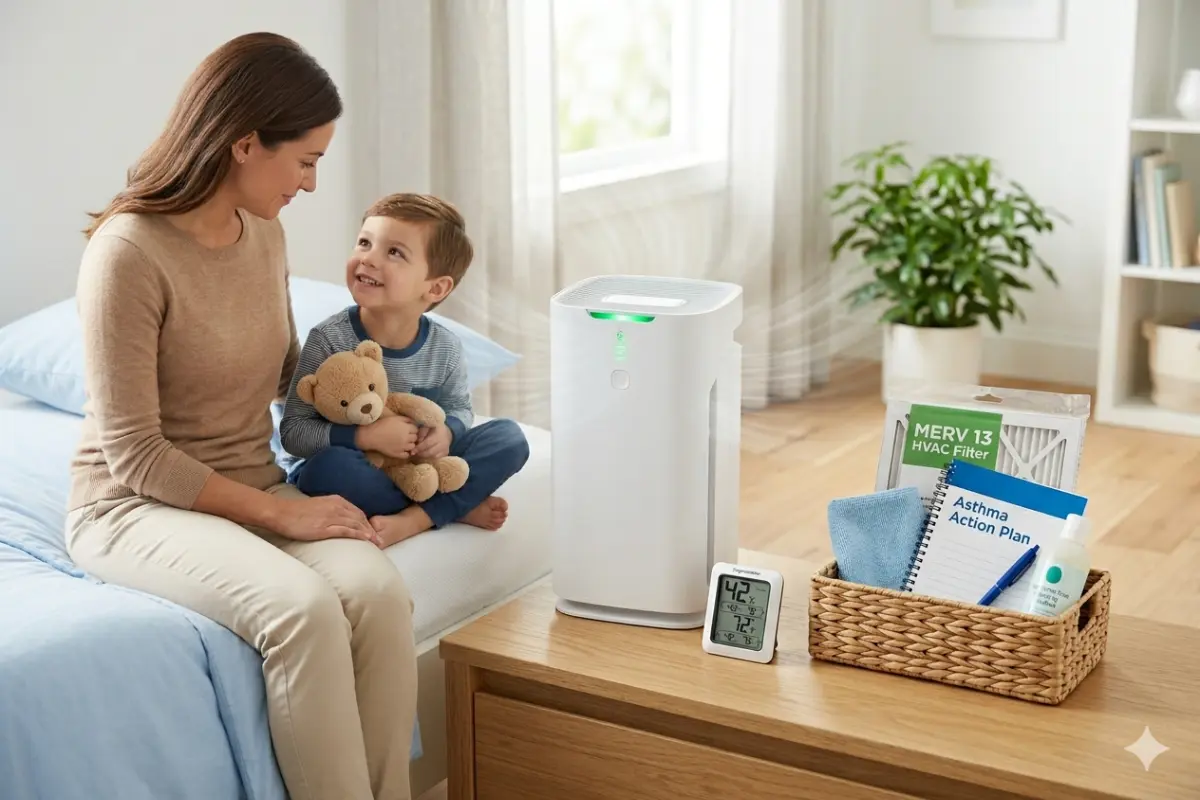
TL;DR: Children with asthma spend most of their time at home, where dust mites, mold, pet dander, and household chemicals can silently trigger attacks. This guide walks parents through six essential home health checks: air quality, humidity and mold, HVAC maintenance, household irritants, the child’s bedroom, and a consistent cleaning routine. Use the checklist at the end to assess your home today and spot what needs fixing first.
If your child has asthma, you’re probably already on top of medications and doctor visits. But here’s what’s easy to miss: childhood asthma now affects 8.1% of the pediatric population, and the home environment is one of the most controllable variables driving those numbers.
Research from Harvard T.H. Chan School of Public Health confirms that early-life exposure to air pollution, including indoor pollutants, meaningfully increases a child’s risk of developing and worsening asthma. That means what’s happening inside your walls matters as much as the prescriptions in your cabinet.
The good news? Most of the highest-impact changes cost very little. They just require knowing where to look. This guide is built around the home health checks that parents of asthmatic children need to do routinely, with practical steps you can start this week. It’s also a good companion resource to keeping young children healthy at home if you have more than one child to manage.
What Are the Most Common Asthma Triggers Inside Your Home?
The six most common indoor asthma triggers are dust mites (found in bedding and upholstery), mold (in damp areas), pet dander, secondhand smoke, volatile organic compounds (VOCs) from cleaning products and air fresheners, and pollen tracked indoors on shoes and clothing. Each one can cause airway inflammation independently, and most homes have more than one present at a time.
The CDC’s Asthma Home Environment Checklist uses exactly these six categories to assess trigger load in a child’s home. A higher number of triggers present correlates directly with worse asthma control and more frequent flare-ups. Most parents are aware of one or two of these but haven’t systematically checked for all six.
Here’s a quick breakdown:
- Dust mites: Too small to see, they live in mattresses, pillows, carpets, and stuffed toys. Their droppings are a major airborne allergen.
- Mold: Thrives in bathrooms, basements, and kitchens. Even small patches release spores that inflame sensitive airways.
- Pet dander: Proteins from skin, saliva, and urine, not just fur. Stays airborne for hours.
- Secondhand smoke: One of the most damaging triggers, with no safe level of exposure for asthmatic children.
- VOCs: Released by cleaning sprays, air fresheners, scented candles, and new furniture. They irritate the airways even at low concentrations.
- Indoor pollen: Tracked in on shoes and clothes, or entering through open windows during high-pollen days.
If you’re not sure which triggers affect your child most, ask your child’s doctor about allergy testing. It makes the rest of these checks much more targeted.
How Do You Check Indoor Air Quality for a Child With Asthma?
Checking indoor air quality for a child with asthma means monitoring for airborne particles, controlling the sources that produce them, and using the right filtration to remove what’s already in the air. A HEPA air purifier in the bedroom, a MERV 11-13 HVAC filter, and a habit of keeping windows closed during high pollen days form the core of an effective strategy.
A landmark study involving 225 children aged 6 to 12 with asthma exposed to secondhand smoke found that homes using HEPA air cleaners had 42 fewer unscheduled asthma visits over the course of the study. That’s a significant reduction, and it came from a single intervention: placing HEPA purifiers in the bedroom and main living area.
That’s worth repeating. One properly placed air purifier in the right rooms, running consistently, produced measurable clinical results. It didn’t require a home renovation.
Here’s what to check and set up:
Air purifiers. Look for a true HEPA unit (not an ioniser or ozone generator, which actually worsen air quality). Place one in your child’s bedroom and one in the main living area. Check that the unit’s CADR (Clean Air Delivery Rate) matches the room size.
HVAC filtration. Your central heating and cooling system filters the air for the whole house. Make sure you’re using the right filter (more on this in the HVAC section below).
Pollen management. Keep windows closed during peak pollen season, especially in the morning when pollen counts are highest. Use the air conditioning instead of natural ventilation on high-count days.
Radon testing. If your home is older or has a basement, the EPA recommends testing for radon every two years. Radon is an invisible radioactive gas and a serious indoor air pollutant that’s easy to miss.
A home air quality monitor is also worth considering. Good models track particulate matter, VOCs, carbon dioxide, and humidity in real time, giving you a dashboard for what your child is breathing.
What Humidity Level Is Safe for a Child With Asthma?
For a child with asthma, indoor humidity should stay between 30% and 50%. The EPA specifically recommends this range to prevent mold growth and keep dust mite populations under control. Both mold and dust mites thrive when humidity climbs above 50%, making them the two biggest reasons to monitor this number consistently.
Dust mites cannot survive when the relative humidity stays below 50% for extended periods. That’s a real, practical lever you can pull without buying anything expensive. A $15 digital hygrometer from any hardware store tells you exactly where your home sits right now.
Here’s what to act on:
Get a hygrometer. Place one in your child’s bedroom and one in the most moisture-prone room (usually a bathroom or basement). Check it weekly. You want to see numbers between 30 and 50% consistently.
Use a dehumidifier where needed. If any room regularly reads above 55%, a dehumidifier brings it back into range. Basements and bathrooms are the most common problem areas. The CPSC recommends keeping all areas clean and dry and addressing any standing water or water-damaged materials immediately.
Run exhaust fans. In bathrooms and kitchens, run the exhaust fan during and for at least 15 minutes after any activity that generates steam. This one habit makes a real difference.
Fix leaks fast. A slow drip under a sink or a small roof leak creates a damp microenvironment that mold colonises within 24 to 48 hours. Don’t wait.
What to do if you find mold. Small patches (under 10 square feet) can be cleaned with soap and water or a diluted bleach solution, then dried completely. Larger patches, or any mold inside walls or HVAC systems, need a professional. Mold spores disturbed during cleaning become airborne, so keep your child out of the room during remediation.
When addressing ventilation concerns, some homeowners consult trusted professionals, much like Austin roofing contractors who assess how ventilation and structural factors interact to protect a home’s overall integrity and airflow balance.
A musty smell anywhere in the home, even without visible mold, is worth investigating. It usually means mold is present somewhere you can’t see it.
How Often Should You Change HVAC Filters if Your Child Has Asthma?
If your child has asthma, you should change your HVAC filter every 60 days, using a filter with a MERV rating between 11 and 13. MERV stands for Minimum Efficiency Reporting Value: it’s a scale from 1 to 16 that measures how small a particle a filter can trap. A MERV 11-13 filter catches dust mites, pet dander, mold spores, pollen, and some bacteria. A standard cheap filter (MERV 4 or below) mostly just protects the equipment.
Homes with asthma or respiratory concerns should use MERV 11 at a minimum, with MERV 13 for more severe cases. The caveat: higher MERV ratings create slightly more resistance in your airflow. Check your HVAC manual to confirm your system can handle MERV 13 before upgrading. Most modern systems can, but it’s worth verifying.
What to do and check:
Set a 60-day reminder. Most households change filters every 90 days. For an asthmatic child, every 60 days is the right schedule. A clogged filter doesn’t just stop capturing new particles. It starts releasing the ones it’s already trapped back into your air.
Check the MERV rating on your current filter. Pull it out and look at the label. If it’s below MERV 8, it’s not doing much for your child’s lungs.
Schedule a professional HVAC inspection annually. A technician can clean the ducts, check for mold inside the system, and confirm that airflow is balanced across all rooms. A poorly maintained HVAC system can spread allergens rather than filter them.
Avoid ozone-generating air purifiers. These are sometimes marketed as “ionisers” or “air sanitisers.” The EPA is explicit: ozone worsens asthma symptoms and should never be used in a home with an asthmatic child.
A smart thermostat with humidity control can also help you manage both temperature and moisture from one device, which reduces the manual monitoring load considerably.
Which Household Products Trigger Asthma in Children?
The main household product categories that trigger asthma are scented cleaning sprays, aerosol products, fragrant candles and diffusers, scented laundry detergents, air fresheners, and VOC-emitting products like fresh paint and new furniture. These release chemical compounds that directly irritate sensitive airways, and the effects can linger for hours after use.
Children exposed to secondhand smoke are 1.5 times more likely to have physician-diagnosed asthma or wheezing than unexposed children. That accounts for an estimated 130,000 excess cases of childhood asthma in the US alone. Smoking outdoors and washing hands after smoking before touching your child reduces exposure, but the only effective policy for an asthmatic child’s home is a strict no-smoking-indoors rule.
Beyond smoke, here’s what to swap and what to stop:
Cleaning products. Switch to fragrance-free, low-VOC alternatives. The “clean” smell from conventional cleaning sprays usually comes from synthetic fragrances that are irritants, not indicators of cleanliness.
Air fresheners and candles. Both scented candles and plug-in fresheners release VOCs and particulates. Open a window instead, or use a HEPA purifier to deal with odours at the source.
Laundry detergent. Many scented detergents leave residue on sheets and clothes that your child inhales during sleep. Fragrance-free versions work just as well and remove a consistent daily exposure.
Aerosol sprays. Hairsprays, furniture polish, cooking sprays, and insecticides all release fine particles. Use pump alternatives where possible, and never use aerosols near your child or in their bedroom.
New furniture and paint. These off-gassing VOCs remain for weeks after purchase or application. When bringing new furniture into the home, air it out in a garage or outdoor area for a few days first. After painting a room, ventilate it thoroughly before your child uses it.
A good habit is to do all cleaning while your child is at school, then ventilate the room well before they return. For a broader seasonal approach to reducing household allergens, the seasonal home allergy reset guide covers a practical room-by-room framework worth bookmarking.
Asthma-Proofing Your Child’s Bedroom
Your child spends 8 to 10 hours in their bedroom every night. That’s the single longest continuous exposure window to any environment in their day. If there’s one room to focus on first, it’s this one.
When I first started looking at our home systematically, the bedroom changes produced the most noticeable difference. The mattress and pillow covers alone changed how many morning symptoms we were dealing with.
Here’s what to address, in order of impact:
Allergen-proof mattress and pillow covers. Dust mites concentrate heavily in mattresses and pillows. An allergen-proof encasement (sometimes called a “dust mite cover”) creates a barrier between your child and the mite population living in the mattress. Wash the encasements monthly.
Bedding temperature. Wash all bedding, including sheets, pillowcases, and blankets, in water heated to at least 130°F (54°C) every week. Studies confirm this temperature kills dust mites. A cooler wash leaves them alive.
Stuffed animals. These are dust mite habitats. Limit the number in the bedroom. Wash weekly in hot water, or seal them in a plastic bag and put them in the freezer overnight once a month (this kills mites but doesn’t remove the allergen, so still wash after).
Flooring. Carpet holds significantly more allergens than hard floors and is nearly impossible to fully clean. If carpet replacement is feasible, bare floors with washable rugs are meaningfully better for air quality.
Air purifier placement. Place the HEPA unit in the bedroom, specifically, not just the living area. Position it between the door and the bed so it’s filtering the air your child breathes during sleep. Don’t put it in a corner where airflow is restricted.
Clutter. Every surface that collects dust is a trigger reservoir. Fewer items on shelves and floors means less to clean and less to accumulate allergens.
Building a Consistent Weekly Cleaning Routine That Actually Works
A single deep clean every few weeks is less effective than a lighter, consistent routine done every week. Buildup prevention is the goal. Allergens like dust mite droppings and mold spores accumulate steadily and require steady removal to stay below the threshold that triggers symptoms.
Here’s a weekly structure that’s realistic without being overwhelming:
Monday: Bedroom focus
- Wash bedding on hot
- Wipe hard surfaces with a damp cloth (dry dusting just redistributes particles into the air)
- Vacuum mattress with HEPA vacuum
Wednesday: Main living areas
- HEPA vacuum all carpets and upholstered furniture
- Wipe down vents and air registers with a damp cloth
- Check humidity readings in the bedroom and bathroom
Friday: Bathrooms and kitchen
- Scrub bathroom surfaces and dry thoroughly
- Run the exhaust fan for 15 minutes after cleaning
- Check under the sink for any moisture or drips
As-needed tasks:
- Replace HVAC filter every 60 days (set a phone reminder today)
- Check the air purifier filter monthly and replace it per the manufacturer’s schedule
- Inspect the basement or crawl space quarterly for moisture or mold signs
Involving older children in some of these tasks also serves a purpose beyond just helping. It builds their own awareness of how their environment connects to how they feel. A child who understands why their bedroom is set up the way it is becomes a more active participant in their own health.
For parents who find consistency difficult to maintain alongside everything else that comes with managing a chronic condition, the support resources for chronic health challenges post is worth reading. You don’t have to do all of this alone, and building consistent healthy habits is itself a skill that takes time to develop.
Your Asthma Home Health Checklist
Use this checklist monthly to track where your home stands.
Air Quality
- [ ] HEPA air purifier running in the bedroom and the main living area
- [ ] HVAC filter rated MERV 11-13 and replaced within the last 60 days
- [ ] Windows kept closed during high pollen days
- [ ] No ozone-generating air purifiers in use
- [ ] Radon test completed (older homes: every 2 years)
Humidity and Mold
- [ ] Indoor humidity reading between 30–50% in all rooms
- [ ] No visible mold in bathrooms, kitchen, or basement
- [ ] No musty smell anywhere in the home
- [ ] Exhaust fans working in the bathroom and kitchen
- [ ] No active leaks under sinks or around windows
HVAC and Ventilation
- [ ] HVAC filter changed within the last 60 days
- [ ] Vents and registers are clean and unblocked
- [ ] Annual HVAC professional inspection completed
Household Irritants
- [ ] All cleaning products are fragrance-free
- [ ] No aerosol sprays used near the child’s spaces
- [ ] No smoking indoors (strict policy in place)
- [ ] No scented candles or plug-in air fresheners in use
- [ ] Laundry detergent is fragrance-free
Bedroom
- [ ] Allergen-proof mattress and pillow covers in place
- [ ] Bedding washed in hot water (130°F+) this week
- [ ] Stuffed animals washed or frozen this month
- [ ] Floors vacuumed with HEPA vacuum this week
- [ ] Air purifier positioned between the door and the bed
Cleaning Routine
- [ ] Weekly damp-cloth dusting completed
- [ ] Vents wiped down this week
- [ ] Bathroom scrubbed and dried this week
- [ ] Humidity checked and logged this week
Bringing It All Together
Managing asthma at home comes down to three things: know your triggers, control what you can control, and build a routine that doesn’t require heroic effort to maintain.
The six checks in this guide, from air quality to your child’s bedroom, give you a complete picture of where your home stands. Most families find two or three areas that need immediate attention and a handful of easy wins they can implement this week.
Use the checklist above once a month. Share it with anyone who watches your child, including grandparents, babysitters, and school staff, if relevant. And if you find something that’s beyond a DIY fix, like significant mold or a failing HVAC system, don’t delay getting professional help. A smaller symptom load for your child is worth the cost.
If you’d like support with the broader challenge of managing a chronic condition as a family, that resource covers practical ways to build your support network and reduce the mental load that comes with long-term health management.
Frequently Asked Questions
How Do I Know If My Home Is Triggering My Child’s Asthma?
The clearest sign is a pattern: symptoms that reliably worsen at home and improve when your child is elsewhere (school, a relative’s house, outdoors). Keep a simple symptom log for two weeks, noting time of day and location of symptoms. If home is consistently the worst environment, use the CDC Asthma Home Environment Checklist to systematically identify triggers. A community health worker or your child’s allergist can also conduct a home visit assessment in some areas.
What Humidity Level is Safe for a Child with Asthma?
The EPA recommends keeping indoor humidity between 30% and 50% for all homes, and this is especially important for asthmatic children. Staying below 50% suppresses dust mite populations and slows mold growth, both of which are major asthma triggers. Pick up a digital hygrometer from any hardware store and place one in your child’s bedroom to monitor the level consistently.
Do Air Purifiers Actually Help Children With Asthma?
Yes, when used correctly. A study of 225 children with asthma found that homes using HEPA air cleaners had significantly fewer unscheduled asthma visits. The key is choosing a true HEPA unit (not an ioniser or ozone generator), sizing it correctly for the room, and running it consistently, particularly in the bedroom during sleep. An air purifier works best as part of a broader strategy that also addresses the sources of allergens in the home.
How Often Should I Replace HVAC Filters If My Child Has Asthma?
Every 60 days, use a filter rated MERV 11 to 13. Standard recommendations are 90 days, but a home with an asthmatic child warrants more frequent replacement. A clogged filter stops capturing new particles and can start releasing trapped allergens back into your air. Set a phone reminder now so it doesn’t get forgotten during a busy period.
Is Carpet Safe for a Child With Asthma?
Carpet holds significantly more allergens than hard flooring and is much harder to fully clean. Dust mites, pet dander, and mold spores all accumulate in carpet fibres where a vacuum can’t reach them all. If carpet replacement isn’t possible, use a HEPA vacuum weekly, keep humidity below 50% (which slows dust mite reproduction), and consider area rugs that can be washed rather than wall-to-wall carpet in your child’s bedroom specifically.
About The Author:
Beth Shamaiengar is a contributing editor at Health Journal. She holds a Bachelor’s degree in Journalism from the University of North Carolina at Chapel Hill and, before joining the Health Journal, became an award-winning writer and editor during 11 years with other publications. She also spent nearly a decade volunteering in PTA leadership roles in local schools, building her skills in marketing, event planning, project management, and communicating with a variety of audiences.