 Healthcare organizations rely on precision, coordination, and trust to deliver safe and effective care. Behind every successful patient outcome is a network of professionals who must share accurate information at the right time. When internal communication breaks down, the consequences can be severe. Misunderstandings, delays, and missing details can all contribute to preventable harm. While technology and clinical expertise continue to evolve, communication remains one of the most critical and vulnerable components of modern healthcare systems.
How Often Does Poor Communication Actually Cause Patient Harm?
Poor communication is the sole cause of patient safety incidents in more than 1 in 10 hospital cases worldwide, and it contributes to 1 in 4 cases overall. In the US specifically, communication failures contribute to over 60% of all hospital-based adverse events. These aren’t edge-case statistics. They represent the most consistent, preventable cause of harm running through the entire healthcare system.
A 2024 systematic review from the University of Leicester covered 46 studies involving 67,639 patients across Europe, North and South America, Asia, and Australia. The findings were consistent across every healthcare system studied. Poor communication wasn’t a background factor in these incidents. It was frequently the direct cause.
Medication errors illustrate the stakes clearly. Over 1,700 lives are lost annually in the UK from medication errors alone, and at least 3 million deaths occur worldwide from patient safety incidents each year. Poor communication is a primary driver in a significant share of those cases, and at least half are considered preventable.
The window with the most risk is the handoff. Research consistently shows that 67% of communication-related medical errors are tied to patient handoffs, the moments between shifts or between departments where patient information transfers from one person to another. The gap isn’t usually a lack of skill. It’s a lack of structure at the exact moment information is most vulnerable to being lost.
One more thing worth knowing: patient safety incidents are significantly underreported across healthcare systems globally. That means the published numbers represent a floor, not a ceiling. The true scale of communication-related harm is larger than any dataset currently captures.
What Are the Hidden Risks of Communication Gaps in Healthcare?
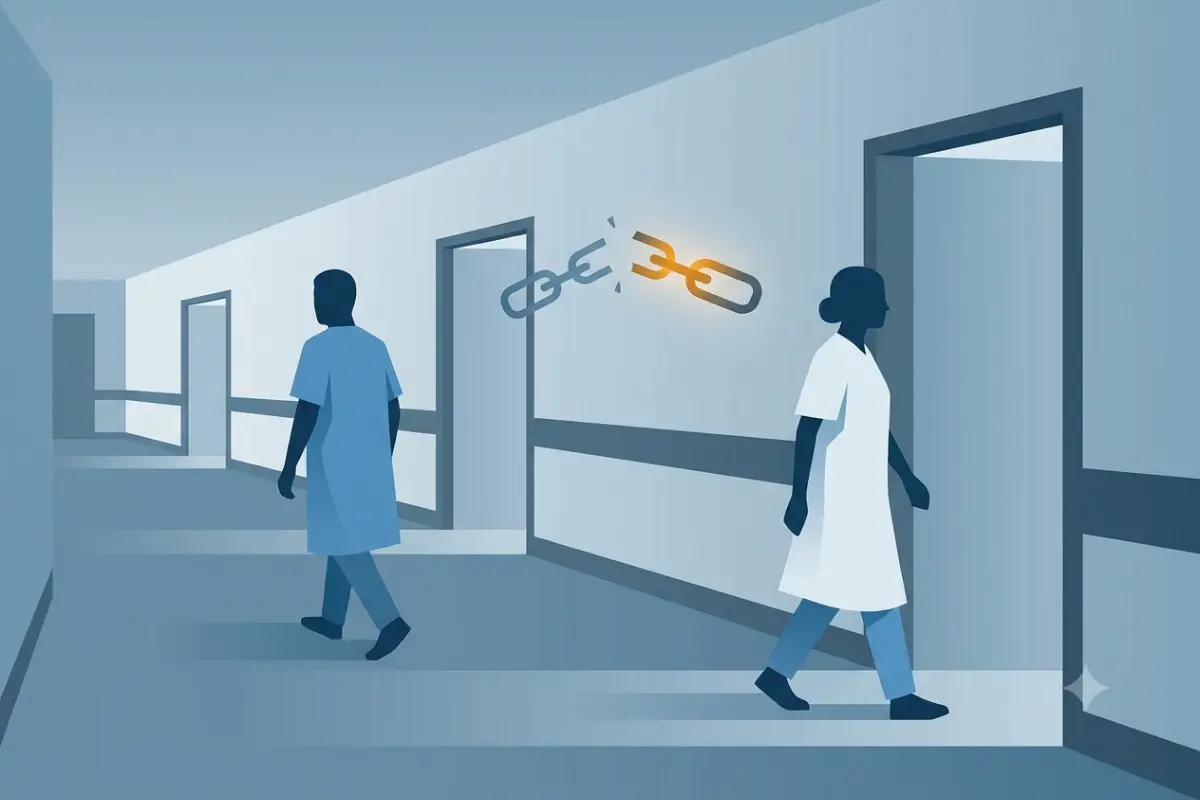
Communication failures can occur at any level of a healthcare organization, from frontline staff to administrative leadership. These gaps often emerge during transitions such as shift changes, patient handoffs, or emergency responses. Even small omissions can escalate quickly, especially when teams rely on fragmented or inconsistent channels to share critical updates.
For example, a nurse who is unaware of a medication change may administer an incorrect dose, or a physician who lacks complete information may make decisions based on outdated data. These errors are rarely the result of negligence. Instead, they reflect systemic shortcomings in how information is exchanged. Without clear and standardized communication protocols, the risk of error becomes embedded in daily operations.
How Do Communication Failures Affect Clinical Decision Making?
Effective communication supports informed and timely decision-making. When communication is unclear or incomplete, clinicians may struggle to assess patient conditions accurately. This can lead to delayed treatments, unnecessary interventions, or missed warning signs.
In high-pressure environments such as emergency departments or intensive care units, the speed and clarity of communication are especially important. Teams must rapidly synthesize information from multiple sources while coordinating complex care plans. A breakdown in communication in these settings can disrupt workflows and compromise patient outcomes.
The integration of prehospital communication plays a role in this process by ensuring that critical information from first responders is relayed accurately to hospital teams. When this exchange is incomplete or delayed, it can hinder preparedness and slow down urgent care efforts. Strong communication frameworks help ensure that every team member has the information needed to act quickly and confidently.
Why Standard Communication Tools Backfire in High-Pressure Settings
Standard communication tools like SBAR and EHR alert systems reduce harm when properly implemented. But in high-pressure clinical environments, compliance drops, alert volumes overwhelm staff, and the structure that’s meant to protect patients becomes background noise. The tool is only as strong as the system around it.
SBAR has a well-documented ceiling problem. Research highlights “a ceiling effect and response bias” in studies evaluating the tool, finding that staff reported high satisfaction with handoff quality even when information was incomplete. The gap between perceived communication quality and actual effectiveness in complex clinical environments is exactly where preventable errors live. A handoff that felt complete wasn’t.
The deeper issue is consistency under pressure. SBAR improves handoff communication when properly integrated into clinical workflows, but staff revert to familiar shortcuts during high-demand moments. A protocol that works reliably in training doesn’t automatically survive a busy overnight shift in an emergency department.
EHR alerts face a different version of the same problem. Healthcare providers override 49 to 96% of drug interaction alerts and other clinical decision support notifications. A system designed to surface critical information ends up generating so much noise that critical alerts get treated the same as low-priority ones. Alert fatigue doesn’t just reduce efficiency. It directly increases safety risk.
The documentation burden makes it worse. Physicians spend approximately 49% of their working time on EHRs and desk work, compared to just 33% on direct patient interaction. When communication tools add to that load rather than reducing it, they work against the clinical attention they were meant to protect.
AHRQ’s TeamSTEPPS 3.0 framework was developed specifically because no single tool addresses teamwork dynamics, role clarity, and patient engagement together. SBAR is a useful piece. It’s not the whole answer.
How Does Organizational Culture Affect Healthcare Communication?
The culture of a healthcare organization has a significant influence on how communication occurs. In environments where staff feel hesitant to speak up or question decisions, important information may go unshared. This silence can stem from hierarchical structures, fear of conflict, or lack of psychological safety.
Encouraging open communication requires leadership commitment and consistent reinforcement. Teams that prioritize transparency and collaboration are more likely to identify and address potential issues before they escalate. Structured communication tools such as standardized handoff protocols or checklists can also support clarity and consistency.
Training programs that emphasize communication skills can further strengthen these efforts. When staff are equipped to convey information clearly and confidently, the likelihood of misunderstandings decreases. Over time, these practices contribute to a safer and more responsive care environment.
Does Healthcare Technology Improve or Worsen Internal Communication?
Advancements in healthcare technology have transformed how information is shared. Electronic health records, messaging platforms, and telehealth systems offer new ways to coordinate care and improve accessibility. However, these tools also introduce complexity.
Poorly designed systems or inconsistent usage can create new barriers to effective communication. For instance, important information may be buried in lengthy digital records, or alerts may be overlooked due to notification fatigue. Technology should support, not hinder, the flow of information.
To maximize the benefits of digital tools, organizations must invest in user-friendly systems and provide adequate training. Integration across platforms is also essential to ensure that data flows seamlessly between departments. When technology aligns with clinical workflows, it can enhance communication rather than complicate it.
How Can Healthcare Organizations Strengthen Internal Communication?
Improving internal communication requires a multifaceted approach that addresses both systems and behaviors. Standardizing communication protocols is a key step. Tools such as SBAR, which stands for Situation, Background, Assessment, Recommendation, provide a structured format for sharing information clearly and efficiently.
Regular team briefings and debriefings can also help ensure alignment and identify potential issues. These discussions create opportunities for staff to clarify responsibilities, share updates, and reflect on performance. In addition, organizations should foster an environment where feedback is encouraged and valued.
Leadership plays a critical role in setting expectations and modeling effective communication. By prioritizing clear and respectful interactions, leaders can influence the broader culture of the organization. Continuous improvement efforts, supported by data and staff input, can help refine communication practices over time.
Building a Communication Infrastructure That Survives Staff Turnover and Scale
This section is for healthcare leaders, quality improvement managers, and clinical informatics teams who already have communication protocols in place and are working on the harder problem: how to make them durable.
Most communication improvement programs succeed because of a small group of motivated people who drive adoption. When those people leave or move on, compliance drops and tools fall into inconsistent use, not because the protocol failed but because it was embedded in individuals rather than systems. Building durable communication infrastructure means encoding the protocol into the workflow itself, not into the memory of whoever championed it.
Data infrastructure is as important as training infrastructure. Organisations that track communication-related adverse events, near-misses, and protocol compliance rates consistently over time can identify drift before it becomes a crisis. Internal tracking gives leaders the real-time picture they need. External benchmarks from The Joint Commission’s sentinel event data provide context, but they reflect only what gets reported, which is a fraction of what actually happens.
Scaling across departments or facilities introduces new failure modes that single-team implementations don’t face: inconsistent terminology between units, different EHR configurations that produce different alert behaviors, and departmental cultures that diverge even within one organisation. Standardisation at the system level, not just the team level, separates organisations with consistently strong safety cultures from those where safety depends on which department you happen to be in.
Five stages for durable communication infrastructure:
- Baseline audit: Map current handoff points, communication channels, and alert configurations. Identify where information is most likely to drop.
- Protocol selection: Choose tools matched to the environment (I-PASS for complex handoffs, TeamSTEPPS for team dynamics, SBAR for rapid escalation) and document them at the system level, not just in training materials.
- Integration into workflow: Build the protocol into scheduling, EHR templates, and shift change logistics so that following the protocol is the path of least resistance, not an extra step.
- Ongoing measurement: Track compliance rates, adverse events, and near-misses monthly. Assign ownership for reviewing the data and acting on it.
- Sustainability review: Conduct a formal communication infrastructure review every 12 months, or whenever significant staff turnover or system changes occur. Communication quality degrades silently. Regular review is what catches it before harm occurs.
Conclusion
The cost of poor internal communication in healthcare extends far beyond operational inefficiencies. It directly impacts patient safety, clinical outcomes, and the overall quality of care. Addressing communication challenges requires intentional effort, from improving systems and processes to fostering a culture of openness and accountability. By strengthening how information is shared and understood, healthcare organizations can reduce risks and provide safer, more effective care for every patient.
About The Author:
Robert W. Bache (aka “Medicare Bob”) is the founder and Chief of Sales for Senior Healthcare Direct, an AmeriLife company. As an independent insurance broker, Bache and his team provide unbiased assistance to current and soon-to-be Medicare beneficiaries, helping them navigate, compare, and find the right Medicare plan options. Bache’s agency, Senior Healthcare Direct, works with 30-plus companies and has served tens of thousands of clients in more than 40 states.