
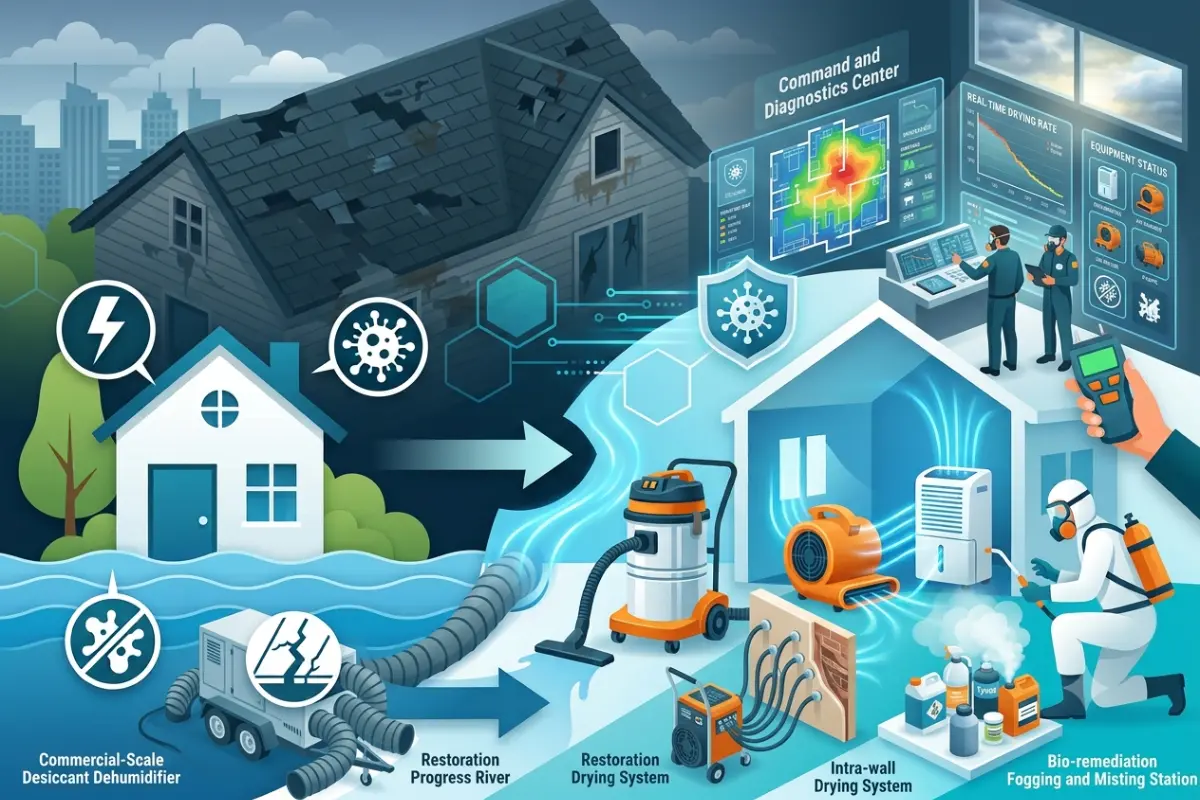
Severe flood damage requires more than just drying visible surfaces. This guide introduces five advanced, expert-level sections covering hidden structural material failures, commercial vs. residential drying strategies, the science of psychrometrics, dangerous DIY myths, and hazardous Category 3 black water protocols. Learn how real restoration professionals use thermal imaging, vapor pressure differentials, and micro-containment setups to protect property integrity and human health when disaster strikes.
1. Why Does Dry-Looking Structural Material Still Fail After Flood Cleanup?
Dry-looking structural materials fail because water often gets trapped behind vapor barriers or inside porous cores. While surface moisture evaporates quickly, dense materials like subfloors and insulation hold water secretly. This trapped moisture slowly rots wood and destroys structural integrity from the inside out.
Standard drying practices often stop too early. Technicians might pack up their gear once your drywall reads “dry” on a basic meter. However, real-world physics tells a different story.
[Wet Subfloor] ──> [Trapped Vapor] ──>
[Glue Breaks Down] ──> [Floor Buckles Weeks Later]
Different building materials react to water in unique ways:
- Cellulose Insulation: This material acts like a giant sponge. According to FEMA, wet cellulose loses its shape, packs down tightly, and holds corrosive water against your home’s wooden frame. It must be completely removed.
- Plywood vs. OSB: Plywood can warp but often regains its strength when dried correctly. Oriented Strand Board (OSB), however, expands and separates when wet. The Wood Association (APA) notes that OSB loses its structural rating once it swells past its engineered limit.
- Hardwood Flooring: Wood has a memory. If water seeps under hardwood, the boards will “cup” or “crown.” Even if the top surface dries, the bottom remains swollen, which eventually ruins the entire floor.
2. How Does Property Type Change the Way Restoration Experts Dry a Building?
Property type dictates the choice of drying equipment because commercial and residential buildings use completely different construction materials. Residential structures rely on porous wood frames that need gentle airflow. Commercial buildings use dense concrete and steel that require industrial desiccant dehumidifiers to extract deep moisture.
The wrong drying strategy can ruin a building. The IICRC sets strict standards, but teams must adapt those standards to the building’s layout.
| Restoration Variable | Residential Properties | Commercial Properties |
| Primary Framing Material | Wood studs (require slow, steady drying to avoid splitting). | Heavy steel or concrete (requires aggressive desiccant drying). |
| Air Distribution | Localized ductwork (easy to isolate room by room). | Plenum spaces above ceilings (high risk of spreading spores across floors). |
| Wall Construction | Standard drywall over wood (easy to flood-cut and replace). | Fire-rated assemblies and vinyl wall coverings (trap water inside walls). |
| Primary Financial Risk | Loss of personal belongings and displaced living conditions. | Massive business interruption costs and structural tenant liabilities. |
3. The Psychrometric Workflow: How Real Experts Manipulate Air to Dry Buildings
Professional restoration teams do not just set up fans and hope for the best. They use a science called psychrometrics. This is the study of how air, moisture, and temperature interact. The Restoration Industry Association (RIA) outlines this advanced process to dry homes efficiently without destroying walls.
Step 1: Calculate Grain Depression
Step 2: Establish Vapor Pressure Differential
Step 3: Deploy Targeted Specialty Dryers
Step 1: Calculate Grain Depression
Technicians use thermal hygrometers to measure Grains Per Pound (GPP). GPP measures the weight of water vapor in the air. The team must lower the GPP of the indoor air below the GPP inside the wet walls. This calculation creates the ideal environment for fast evaporation.
Step 2: Establish a Vapor Pressure Differential
Water naturally moves from areas of high pressure to areas of low pressure. By running Low Grain Refrigerant (LGR) dehumidifiers, pros lower the vapor pressure of the room air. According to OSHA, keeping this pressure imbalance constant pulls water out from deep inside structural framing.
Step 3: Deploy Targeted Pressure Systems
Instead of tearing out expensive wood paneling or kitchen cabinets, pros use specialized systems like Injectidry. These tools use small tubes to pump dry, pressurized air directly into wall cavities through tiny holes behind baseboards. This saves expensive finishes and lowers overall repair bills.
4. Can You Use Bleach to Kill Mold on Flooded Wood and Drywall?
No, you cannot use bleach to kill mold on porous materials like wood and drywall. Bleach contains mostly water. The chlorine stays on the surface while the water seeps into the wood, which actually feeds the mold roots underneath. This causes the mold to return stronger a few days later.
[Apply Bleach] ──> [Chlorine Stays on Surface / Water Soaks In] ──>
[Surface Looks Clean] ──> [Deep Roots Grow Stronger]
Misinformation about flood cleanup can destroy your property and harm your health. The EPA offers clear guidance to separate dangerous myths from real science:
Myth: Opening your windows helps a flooded house dry out faster.
Reality: If the outdoor humidity is higher than the indoor humidity, opening windows brings more water into your home. Pros seal the house to create a controlled environment.
Myth: If the carpet looks clean after drying, you can keep the original padding underneath.
Reality: Carpet padding acts like a sponge for bacteria. The CDC states that padding soaked in storm runoff or sewer water cannot be sanitized. It must be thrown away to protect your health.
Myth: Spraying air freshener will eliminate the musty odor left behind by a flood.
Reality: Musty odors mean mold or bacteria are currently growing. Spraying air freshener covers up a warning sign. You must find and remove the wet material causing the smell.
5. The Category 3 Biohazard Protocol: How Professionals Handle Black Water
Category 3 water, or black water, is highly dangerous. This includes sewage backups, rising river water, and storm surges. When storm surges and coastal flooding strike, a Long Island-based restoration company helps property owners document all damage comprehensively, which is invaluable when filing accurate and complete insurance claims. This water carries toxic chemicals, heavy metals, and live pathogens. The WHO warns that contact with black water without proper gear can lead to severe waterborne illnesses.
Professional crews follow a strict containment and cleaning framework to handle these risks safely:
[Isolate the Zone] ──> [Remove Porous Items] ──>
[Biocide Wash] ──> [Clearance Testing]
1. Establish Negative Pressure Isolation
Before moving any wet items, pros seal off the damaged rooms with heavy plastic sheeting. They use Air Scrubbers equipped with HEPA filters to create negative air pressure. According to NIOSH, this step keeps dangerous airborne bacteria from drifting into clean parts of your building.
2. Aggressive Source Removal
In a black water scenario, saving porous items is impossible. Crews remove and discard all drywall, insulation, carpeting, and baseboards that touched the water. These materials trap pathogens inside their fibers, making them impossible to safely clean.
3. Two-Step Biocide Sanitization
Once the structure is stripped down to bare studs, technicians apply specialized biocides. They do not use standard household cleaners. They use industrial disinfectants registered with the EPA that are proven to kill viruses and bacteria on contact.
4. Post-Remediation Testing
Before rebuilding starts, independent inspectors test the air and surfaces. This clearance testing checks for lingering bacteria and mold spores. This step ensures your home or business is completely safe to live and work in again.
Frequently Asked Questions
How long does the professional flood drying process typically take?
The standard structural drying process usually takes between three and five days. However, this timeline can stretch significantly longer if dense concrete slabs or multi-layered subfloors are saturated. According to guidelines by the IICRC, technicians must monitor daily moisture readings until the materials reach their predetermined dry standard goals.
Can mold grow back after professional remediation is complete?
Mold will not grow back if the underlying moisture source is entirely removed and the relative humidity stays below 60 percent. If a hidden pipe leak continues or if structural materials are not thoroughly dried down to their deep cores, spores will reactivate. Professional firms use thermal cameras and specialized moisture meters to ensure no hidden damp pockets remain before reconstruction begins.
Is carpet salvageable after a severe indoor flood?
Whether a carpet can be saved depends entirely on the category of the floodwater. If the water came from a clean source like a burst water line, the carpet can usually be sanitized and reinstalled with new padding. However, the CDC warns that any carpet soaked by Category 3 black water, such as sewage or outdoor storm runoff, is a biohazard and must be destroyed.
Does homeowner’s insurance cover the cost of professional flood restoration?
Standard homeowners insurance policies typically cover sudden internal water damage like burst pipes, but they do not cover rising outdoor floodwaters. To get coverage for natural disasters or coastal storm surges, property owners must have a separate policy through the National Flood Insurance Program. Working with a certified restoration company helps ensure all physical damage is meticulously documented for your adjuster.
What is the difference between an air mover and a standard household fan?
Industrial air movers are specifically engineered to focus high-velocity airflow along the floor surface to pull moisture directly out of building materials. Standard household residential fans simply circulate the ambient air within a room without changing the surface vapor pressure. True structural drying requires industrial air movers working alongside commercial dehumidifiers to extract the evaporated moisture completely from the indoor environment.
About The Author:
Beth Shamaiengar is a contributing editor at Health Journal. She holds a Bachelor’s degree in Journalism from the University of North Carolina at Chapel Hill and, before joining the Health Journal, became an award-winning writer and editor during 11 years with other publications. She also spent nearly a decade volunteering in PTA leadership roles in local schools, building her skills in marketing, event planning, project management, and communicating with a variety of audiences.