
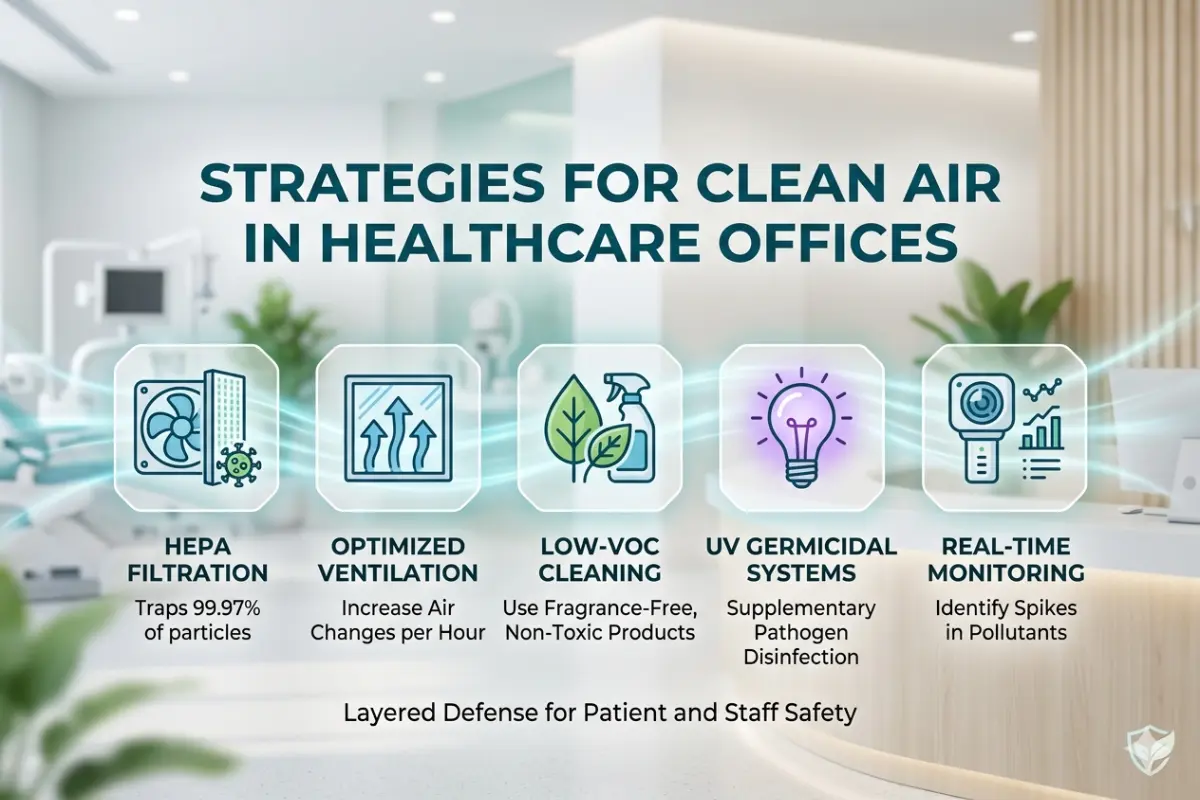
TL;DR: Poor indoor air quality in healthcare settings contributes to hundreds of millions of healthcare-associated infections globally each year, costing over $200 billion in high-income countries alone. The fix isn’t one thing: it’s layered. HEPA filtration, proper ventilation rates, low-VOC cleaning products, UV germicidal systems, and real-time air sensors all work together. Use the checklist at the end to audit where your facility stands right now.
Hundreds of millions of patients are affected by healthcare-associated infections (HAIs) every year, with an economic burden exceeding $200 billion in high-income countries. And a significant portion of those infections travels through the air.
Most facilities still treat indoor air quality (IAQ) as a compliance issue. Check the ventilation box, replace filters on schedule, and move on. But academic medical centers are now examining how IAQ relates to patient outcomes in oncology, surgical recovery, and high-risk departments, and the early results are hard to ignore. Better air is linked to fewer post-surgical complications, lower readmission rates, and healthier staff.
The air in a medical office isn’t just a comfort issue. It’s a patient safety issue, full stop.
What Makes Air Quality So Dangerous in Healthcare Settings?
Healthcare facilities face airborne risks that standard commercial buildings simply don’t. The mix of patients, procedures, and cleaning chemicals creates a unique contamination environment where poor air quality can directly harm the people it’s supposed to protect.
In patient care areas, especially ICUs, oncology wards, and surgical suites, air quality is as critical as medication accuracy or sterile technique. That’s not an exaggeration. It’s how the National Air Filtration Association frames it in their 2026 guidance.
The risk is especially concentrated around immunocompromised patients. Cancer patients, transplant recipients, and HIV patients have weakened immune defenses. Even minor exposure to airborne pathogens can trigger serious infections in these groups. A contamination level that’s unremarkable for a healthy person can be dangerous for someone on chemotherapy.
The contaminants themselves are varied. Hospital indoor air carries VOCs, formaldehyde vapours, particulate matter (PM2.5), CO2, and anesthetic gases from procedures, cleaning products, building materials, and human movement. Outdoor air pulled through ventilation systems adds ozone and additional particulate load on top of that.
Staff face their own risks, too. Poor IAQ in staff work zones reduces concentration, increases fatigue, and drives up sick leave. That’s a clinical performance issue, not just a wellness one.
Identifying what’s in your air is the starting point. Fixing it requires a layered approach.
What Filtration Systems Actually Work in Medical Offices?
HEPA (High-Efficiency Particulate Air) systems are the premier gold standard for clinical settings. True HEPA filters capture 99.97% of airborne particles down to 0.3 microns, effectively neutralizing viral aerosols, bacteria, and fungal spores. When run at 6 to 12 air changes per hour, they reduce airborne viral load by 40% to 90%.
The numbers are specific. HEPA filtration achieves 99.97% removal of SARS-CoV-2 after 7 air changes, and HVAC-HEPA combinations operating at 6-12 air changes per hour (ACH) reduce infection risk by 40-90% compared to standard ventilation. Real-world ICU deployments have seen HAIs and bioaerosols drop by 70-90%.
A December 2024 Lancet review of 18 studies confirmed HEPA as the most frequently referenced filtration intervention. One study found that adding a HEPA filter to a consultation room reduced PM2.5 aerosol concentration by at least 50%. Another showed that SARS-CoV-2 previously detected in a COVID ward was no longer detectable after a HEPA filter was introduced, then reappeared when the filter was removed.
For general outpatient facilities, ASHRAE 62.1 guidelines recommend a minimum MERV 8 filter. For higher-risk areas like procedure rooms and oncology suites, HEPA is the standard. The distinction matters. A MERV 8 filter that’s adequate for a consult room would be insufficient for a room treating immunocompromised patients.
Maintenance matters as much as the filter rating. A clogged or overdue filter performs like no filter at all. Most facilities underestimate how quickly filter efficiency degrades under real-world use. Check replacement schedules and reducing indoor allergens through consistent filter upkeep is a concrete, low-cost intervention.
In addition to central filtration, localized solutions can be used in areas where contaminants are generated more frequently. For example, specialized equipment such as a quality 3d printer dust collector can help capture fine particulate matter produced by in-office fabrication processes, preventing it from spreading into patient care areas.
How Ventilation Design Shapes Everything Else
Filtration removes particles. Ventilation dilutes and removes contaminated air. You need both.
ANSI/ASHRAE/ASHE Standard 170-2021 sets specific requirements for healthcare ventilation: a minimum of 4 ACH for exam rooms and 2 ACH for consult rooms in general outpatient facilities. Higher-acuity areas have stricter requirements still. These aren’t guidelines; in most jurisdictions, they’re regulatory minimums.
Negative pressure rooms deserve specific attention. They’re designed to contain airborne contaminants by keeping the room pressure lower than the surrounding corridor. Air flows inward when a door opens, rather than outward into the hallway. They’re standard for isolation settings and are one of the most reliable tools for preventing cross-contamination in airborne illness scenarios.
Stagnant air zones are a common problem in facilities with inconsistent airflow design. Corners, alcoves, and poorly serviced rooms can accumulate particulate matter and pathogen-laden air without anyone noticing. Good ventilation design addresses distribution, not just volume.
The most recent shift is toward smart systems. AI-powered platforms and occupancy tracking sensors can now increase ventilation in a crowded waiting room and reduce it in an empty space automatically, improving both air quality and energy efficiency. This used to require manual monitoring and adjustment. Today it’s a software setting.
Are Your Cleaning Products Making the Air Quality Worse?
This is the part most healthcare facilities miss. The products used to keep surfaces sterile are themselves a significant source of indoor air pollution.
Many common hospital disinfectants release volatile organic compounds (VOCs) into the air during and after application. VOCs are airborne chemicals that accumulate in enclosed spaces and cause respiratory irritation, headaches, and, with long-term exposure, more serious health conditions. According to the CDC, long-term exposure to VOCs is linked to liver and kidney damage and certain cancers.
The impact on staff is measurable. Research shows that 55% of hospital cleaning staff report eye irritation and 24% report skin problems from disinfectant exposure. A separate study found that longer employment in roles using cleaning agents was associated, in a dose-related way, with increased risk of work-related asthma and respiratory symptoms. The products aren’t optional. But the chemistry can be changed.
Switching to low-VOC, fragrance-free cleaning solutions reduces airborne chemical load without compromising disinfection. This is especially important in how air pollutants affect the whole body: chemical exposure isn’t isolated to the respiratory tract. It affects systemic inflammation, hormonal signaling, and gut microbiome balance over time.
Spraying is worse than wiping. Spray applications disperse fine chemical droplets into the breathing zone. Cloth or disposable wipe application keeps chemicals on the surface rather than in the air. Where spraying is necessary, doing it in well-ventilated spaces immediately after patients have cleared the room makes a real difference.
Staff training on proper handling, ventilation during cleaning, and product selection is often the cheapest intervention with the highest return.
Does UV Germicidal Irradiation Actually Help?
Yes, as one layer of a broader system. UVGI (ultraviolet germicidal irradiation) uses UV-C light in the 250-270 nanometer wavelength range to inactivate microorganisms by disrupting their DNA. It can’t replicate, so it can’t infect.
The CDC’s NIOSH guidance (updated October 2024) describes UVGI as a supplemental form of ventilation intervention, best used alongside HVAC systems with filtration, not as a replacement for either. That’s an important distinction. Facilities that install UVGI and reduce other measures are going backwards.
There are 2 main configurations. In-duct UVGI disinfects air as it passes through HVAC ductwork, which works well at scale for an entire building. Upper-room UVGI units mount near the ceiling and disinfect air in the upper portion of occupied rooms, creating a “clean air layer” above patient height. Upper-room UVGI has been in use for over 70 years in tuberculosis control.
The evidence supports using UVGI to augment HEPA and ventilation in high-risk areas: procedure rooms, isolation rooms, and areas with high patient turnover. For general outpatient spaces with good baseline filtration and ventilation, it’s a meaningful upgrade but not always the priority.
Cost has dropped significantly. LED-based UVGI fixtures are becoming more energy-efficient and longer-lasting, making them feasible for smaller practices that would have considered them out of reach a few years ago.
How Real-time Air Quality Monitoring Changes What’s Possible
Knowing your air is clean is different from assuming it is. Real-time monitoring is what closes that gap.
Modern IAQ sensors continuously track particulate matter (PM2.5 and PM10), VOCs, CO2, temperature, and humidity. They feed that data to dashboards that flag when any metric crosses a threshold, before the problem becomes clinically visible. Installing IAQ monitoring devices allows facilities to identify correlations between air quality levels and potential causes, enabling swift corrective action.
The shift from reactive to proactive is the real value. Most facilities only discover IAQ problems when someone complains about a smell or a room feels uncomfortable.
Smart building integration takes this further. AI-powered platforms can automatically adjust airflow based on real-time conditions, flag changes in air pressure relationships, and reduce manual monitoring burden for facilities staff. A crowded waiting room gets more ventilation automatically. An unoccupied wing gets less. The system is always optimizing.
Conclusion
Clean air strategies in healthcare aren’t about comfort. They’re about infection control, staff health, and patient safety, all measurable, all improvable.
3 things worth holding onto. IAQ is a clinical intervention, not a facilities checkbox. Layering filtration, ventilation, low-VOC cleaning, UVGI, and monitoring is what the research actually supports; any single measure alone is insufficient. And real-time sensors have crossed the affordability threshold, where every practice can have them.
The checklist below is a fast way to see where your facility stands. Work through it, identify the gaps, and start with the items that directly affect patient-facing areas first.
Clean air checklist for healthcare and medical offices
Filtration
- [ ] HVAC system uses a minimum MERV 8 filter for general outpatient areas
- [ ] High-risk and procedure rooms use HEPA-grade filtration
- [ ] Filter replacement schedule is documented and followed
- [ ] Portable HEPA air cleaners supplement central filtration in high-turnover areas
- [ ] Filters are inspected visually between scheduled replacements
Ventilation
- [ ] Exam rooms meet the ASHRAE 170 minimum of 4 ACH
- [ ] Consult rooms meet the minimum of 2 ACH
- [ ] Isolation rooms have verified negative pressure
- [ ] Airflow design has been reviewed for stagnant zones
- [ ] Ventilation system has been inspected or tested in the past 12 months
Cleaning products
- [ ] All cleaning products have been assessed for VOC content
- [ ] Low-VOC, fragrance-free disinfectants are used where possible
- [ ] Staff are trained to wipe rather than spray wherever applicable
- [ ] Cleaning is done in well-ventilated spaces with patients cleared
- [ ] A green cleaning protocol is documented and accessible to all staff
UV germicidal irradiation
- [ ] UVGI is installed in high-risk areas as a supplemental layer
- [ ] In-duct or upper-room UVGI configuration has been evaluated for each area
- [ ] UVGI is used alongside, not as a replacement for, filtration and ventilation
- [ ] UV-C fixture performance and bulb life are checked regularly
Monitoring
- [ ] Real-time IAQ sensors are installed in patient-facing areas
- [ ] Sensors track PM2.5, VOCs, CO2, temperature, and humidity
- [ ] Alerts are configured for when any metric exceeds a safe threshold
- [ ] Monitoring data is reviewed regularly by facilities management
- [ ] IAQ data is integrated into quality improvement and accreditation records
Frequently Asked Questions
What MERV Rating Do Medical Offices Need for HVAC Filters?
General outpatient medical offices typically need a minimum MERV 8 filter under ASHRAE 62.1, which applies to commercial and office-style clinical spaces. For higher-risk areas (procedure rooms, oncology spaces, rooms treating immunocompromised patients), HEPA-grade filtration is the standard. HEPA captures 99.97% of particles at 0.3 microns, well beyond what MERV 8 achieves. The right rating depends on what’s happening in the room, not just the building type.
How Often Should HEPA Filters Be Replaced in a Healthcare Setting?
Replacement frequency depends on usage and local air quality conditions, but most healthcare HEPA filters need replacement every 6-12 months in active patient care areas. High-traffic or high-contamination spaces may require more frequent changes. The best approach is to track differential pressure across the filter: when resistance rises significantly, efficiency drops, and replacement is due regardless of the calendar schedule. Visual inspection alone isn’t reliable for HEPA filters.
Can Plants Improve Indoor Air Quality in a Medical Office?
Plants provide limited and inconsistent IAQ benefits in clinical settings, and they carry their own infection control risks. Soil and standing water can harbor mold and bacteria, making them problematic near immunocompromised patients. NASA’s plant-based air cleaning research, often cited in wellness content, involved closed chamber conditions that don’t translate to real-world ventilated spaces. For medical offices, mechanical filtration and ventilation are far more reliable and controllable than plant-based approaches.
What’s the Difference Between Negative and Positive Pressure Rooms?
Negative pressure rooms have air pressure lower than the surrounding corridor, so air flows into the room when a door is opened rather than out. This contains airborne pathogens inside the room and is used for infectious disease isolation. Positive-pressure rooms do the opposite: air flows outward to prevent outside contaminants from entering. Positive pressure is used to protect highly vulnerable patients (bone marrow transplant recipients, for example) from environmental pathogens. Both require dedicated HVAC design and regular pressure verification.
How Do I Know If My Medical Office has a VOC Problem?
Common signs include staff reporting persistent headaches, eye irritation, or respiratory symptoms, particularly shortly after cleaning. Patients may notice unusual chemical smells. But VOCs are often odorless at health-affecting concentrations, which is why sensory detection isn’t reliable. The only accurate way to know is real-time VOC monitoring with calibrated sensors. If your facility doesn’t have continuous IAQ monitoring, a professional indoor air quality assessment with sampling equipment is the right starting point. Switching to low-VOC cleaning products is a reasonable precautionary step regardless.
About The Author:
Beth Shamaiengar is a contributing editor at Health Journal. She holds a Bachelor’s degree in Journalism from the University of North Carolina at Chapel Hill and, before joining the Health Journal, became an award-winning writer and editor during 11 years with other publications. She also spent nearly a decade volunteering in PTA leadership roles in local schools, building her skills in marketing, event planning, project management, and communicating with a variety of audiences.