
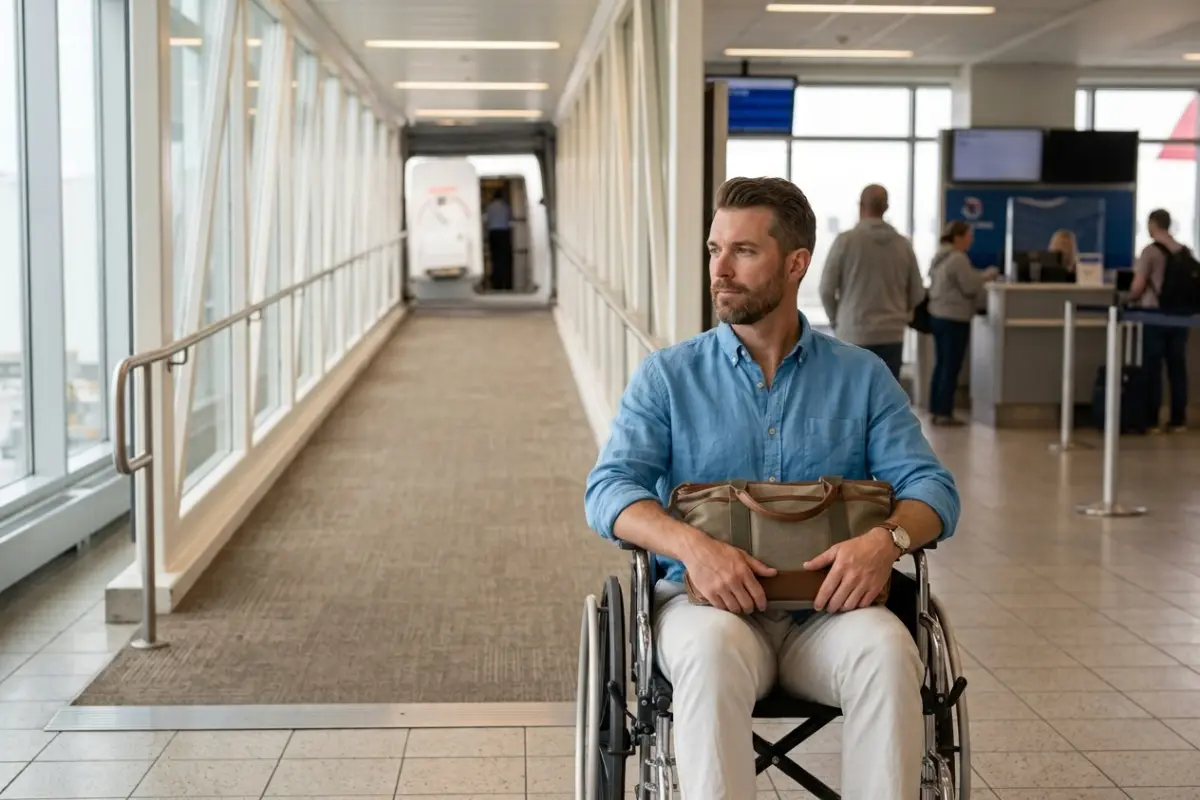
Air travel presents unique challenges for passengers with disabilities. Whether someone uses a wheelchair, has a hearing impairment, experiences anxiety in enclosed spaces, or manages a chronic health condition, the airport environment and airplane cabin can feel overwhelming without proper support. Airlines have both a legal obligation and a practical responsibility to ensure that all passengers can travel safely and comfortably.
Understanding what accommodations exist empowers disabled travelers to advocate for themselves and helps airlines recognize their role in creating truly inclusive travel experiences.
1. What Boarding and Seating Accommodations Can Airlines Offer Passengers With Disabilities?
Airlines can offer priority boarding, seats that fit a passenger’s needs, and a quick check-in about those needs during booking. In the U.S., travelers who tell the gate they need extra time must get the chance to board early, and airlines must give specific seats, like ones with movable armrests, to those who ask.
One of the most fundamental accommodations an airline can provide is accessible boarding and seating. Passengers with mobility limitations often need extra time to navigate airport terminals and board aircraft without rushing. Airlines can offer priority boarding for travelers with disabilities, allowing them to board before general passengers and avoid crowded aisles.
Additionally, airlines should reserve seats near restrooms and exits for passengers who require frequent bathroom access or need quick egress in case of emergency. Seat width, armrest configuration, and proximity to assistance also matter significantly. Some passengers require aisle seats to accommodate service animals or medical equipment, while others need bulkhead seating for additional legroom. When airlines communicate directly with disabled passengers during the booking process to confirm seating needs, the entire travel experience becomes substantially less stressful.
Smart Moves for Boarding and Seating
- Name your seat need when you book. If you need a movable aisle armrest, a bulkhead seat for a service dog, or extra legroom, ask for it by name. Airlines must give these seats to passengers who ask when the seat exists in your class of service.
- Tell the gate agent you need extra time. Airlines with open seating may board you right after the first group instead of before everyone. Either way, speaking up at the gate is what triggers the help.
- Know the exit-row rule. Airlines can only place passengers in exit rows if they can do the tasks an emergency evacuation needs. If that’s not you, ask for a nearby row instead.
- Ask for a seat next to your helper. A personal care attendant, reader, or interpreter can sit in the seat next to you when you need that kind of help.
2. How Can Airlines Make Restrooms and In-Flight Help More Accessible?
Airlines can use planes with larger restrooms, train flight attendants to help with privacy and dignity, and offer an on-board wheelchair on request. Federal rules require accessible restrooms on planes with two aisles, and a 2023 DOT rule extends bigger, more accessible restrooms to new single-aisle planes with 125 or more seats.
Airplane restrooms present significant barriers for many disabled travelers. Standard aircraft lavatories are cramped, with limited space for wheelchairs, walkers, or assistance from a companion. Airlines can identify which aircraft in their fleet have larger or wheelchair-accessible lavatories and assign those planes to flights when disabled passengers are traveling.
Flight attendants should receive training on assisting passengers who need restroom help, including understanding privacy needs and proper assistance techniques. Airlines can also allow service animals or personal care attendants to accompany passengers to the restroom when medically necessary, and some carriers provide catheters or other necessary supplies for passengers with specific medical needs. These accommodations recognize that basic bodily functions should not be compromised by air travel.
Simple Solutions for Restrooms and In-Flight Help
- Ask about the restroom before you book. Airlines must tell you, on request, whether your plane has an accessible restroom.
- Request an on-board wheelchair. If your plane’s restroom is too small, you can still ask for an on-board wheelchair to reach it. Give the airline notice first so it can have one ready.
- Plan a restroom stop before boarding. At the airport, airlines must help you reach a restroom entrance if time allows.
- Say how much help you want. Airlines can’t make you accept a type of help you didn’t ask for. Tell the crew what works for you.
3. How Do Airlines Support Deaf, Hard of Hearing, and Low-Vision Passengers?
Airlines must give passengers who say they need hearing or vision help the same trip and safety information as everyone else, in a form they can use. That can mean writing notes or giving a spoken walk-through of the safety card, plus staff trained to spot these needs.
Passengers who are deaf, hard of hearing, blind, or low vision require specific communication accommodations to navigate the airport and flight safely. Airlines should provide real-time captioning or interpreters for passengers who are deaf or hard of hearing, particularly during safety briefings and in-flight announcements. For passengers who are blind or low vision, airlines can offer detailed verbal descriptions of the safety card, seating layout, and emergency procedures.
Flight crews should understand how to assist passengers with visual disabilities during boarding, deplaning, and cabin navigation. Technology can support these efforts through visual alert systems for deaf passengers or accessible audio descriptions of in-flight entertainment. When airlines train staff specifically in these communication methods, they eliminate confusion and ensure that critical safety information reaches every passenger on board.
Helpful Strategies for Communication Access
- Say what you need at the first desk you reach. Tell staff at the ticket counter or gate that you need hearing or vision help. Airlines must then give you the same trip information as other passengers.
- Carry an info sheet. Staff must be trained to read an information sheet that you hand them. It’s a handy option for deaf-blind travelers.
- Check the airline’s website and kiosks. On planes with more than 60 seats, an airline’s main website must be accessible. If a site or kiosk doesn’t work with your tools, tell the airline.
4. Service Animal and Medical Equipment Accommodations on Flight
Passengers with disabilities often rely on service animals or specialized medical equipment to maintain their independence and health. Airlines can accommodate these needs by allowing service animals to remain with their handlers throughout the flight in the cabin rather than requiring them to be caged. Proper crew training helps distinguish between legitimate service animals and pets, ensuring safety while respecting disability rights.
Beyond animals, airlines should accommodate medical equipment such as ventilators, oxygen tanks, wheelchairs, and CPAP machines, with clear policies on what can be stowed in the cabin and what requires special placement in the cargo hold with climate control. Passengers taking medications on specific schedules need access to water, refrigeration for certain medications, and time to take medications without pressure. Flight crews with a basic understanding of common medical conditions can offer discreet assistance, such as helping a passenger with arthritis open a medication bottle or retrieving necessary supplies from an overhead bin.
Practical Advice for Service Animals and Medical Gear
- Finish your DOT forms early. Airlines can require DOT’s service animal forms, and some can ask for them up to 48 hours before your flight. Long flights of 8 hours or more also call for a relief form.
- Remember the “dogs only” rule. Under DOT’s 2020 rule, only trained dogs count as service animals. Emotional support animals no longer do.
- Check your oxygen device against FAA rules. The FAA lets passengers use portable oxygen concentrators that meet its acceptance criteria. Check your model before you pack.
- Keep medicine and devices in your carry-on. Airlines must let you carry assistive devices, medical devices, and a personal supply of medication in the cabin for free. They don’t count toward your carry-on limit.
5. How Can Airlines Make Ground Transportation and Boarding Bridges More Accessible?
Airlines can keep boarding bridges working and offer ramps or lifts when no bridge is available. U.S. rules require an accessible route from the gate to the plane, and ramps or lifts at most U.S. airports when level boarding isn’t possible.
The journey from the terminal gate to the airplane cabin involves multiple transition points that can be difficult for disabled passengers. Airlines can ensure that boarding bridges are properly functioning and accessible, with smooth transitions that do not require navigating stairs or steep inclines. When boarding bridges are unavailable, airlines should offer alternative accessible boarding methods rather than requiring disabled passengers to use stairs or wheelchair lifts that may feel unsafe or undignified.
On the ground, shuttle buses should have wheelchair lifts or ramps, adequate space for mobility devices, and priority seating for disabled passengers. Ground crews managing aircraft turnaround, including those operating an electric GPU to power the aircraft during boarding, play a supporting role in keeping the gate environment running smoothly so that disabled passengers experience minimal delays during the most vulnerable moments of their journey. Smooth ground operations combined with accessible aircraft boarding ensure that mobility and other disabilities do not prevent someone from traveling with confidence.
Easy-to-Apply Tips for the Gate-to-Cabin Trip
- Ask how you’ll board. If you use a wheelchair for boarding, airlines must tell you about limits on level-entry boarding, even if you don’t ask.
- Tell staff you requested help. If you asked for assistance ahead of time, say so when you reach the airport or gate.
- Watch the clock. If you can’t move on your own, airlines can’t leave you in a wheelchair for more than 30 minutes.
- Say no to being carried. Airline staff must never hand-carry you on or off a plane, except in an emergency. Ask for a lift or ramp instead.
Conclusion
Airlines hold the power to transform air travel from an anxiety-inducing experience into a manageable, dignified one for disabled passengers. By implementing accessible boarding and seating, improving restroom facilities, providing communication support, accommodating service animals and medical equipment, and ensuring accessible ground transportation, airlines demonstrate a genuine commitment to inclusion. These accommodations are not luxuries or special favors; they are essential features of accessible travel infrastructure. Disabled passengers deserve the same freedom to fly as anyone else, and airlines that prioritize these measures recognize that accessibility benefits all travelers while honoring the rights and dignity of people with disabilities.
About The Author:
Beth Shamaiengar is a contributing editor at Health Journal. She holds a Bachelor’s degree in Journalism from the University of North Carolina at Chapel Hill and, before joining the Health Journal, became an award-winning writer and editor during 11 years with other publications. She also spent nearly a decade volunteering in PTA leadership roles in local schools, building her skills in marketing, event planning, project management, and communicating with a variety of audiences.