

TL; DR: A high-conflict divorce creates intense pressure on every decision you make. Setting firm, written boundaries protects your mental health and strengthens your legal position at the same time. This post covers the 4 most important boundary rules, including how parallel parenting reduces daily conflict, how to enforce consequences, and how to use communication tools that create a clear record. Read the 4 rules below to start protecting yourself today.
Navigating a high-conflict divorce can feel like a bumpy airplane ride, unpredictable, stressful, and (yes) turbulent.
But you don’t have to feel like you are simply sitting there waiting for the oxygen masks to drop. There are many ways you can protect yourself against the turbulence of a high-conflict divorce, from building a strong support system to working with an attorney with proven experience in these situations. Having the right people in your corner allows you to weather the ups and downs with more confidence.
Of course, it can be a tough lesson to remember that the most important person to have in your corner during your divorce is YOU! It’s critical to remember that the steps you take right now to protect yourself and your interests are key to achieving your goals. One of the best ways to start doing this is by setting healthy boundaries.
Why are healthy boundaries difficult in high-conflict divorces?
Boundaries are hard enough to set in the most positive of circumstances, and when it comes to high-conflict situations, they can be notoriously difficult to identify, never mind effectively maintain. Even when you know boundaries are the right step, you can get lost in the details.
But why is that? There are lots of meaningful reasons why it can be hard to draw the line. Here are a few.
Boundaries are hard to maintain when emotions run high
High-conflict divorces can bring a greater degree of emotional intensity, and these intense emotions can often cloud judgment and perception. Strong feelings like anger or fear can overwhelm coping mechanisms; these emotions can trigger your nervous system to go into high-alert mode.
As a result, it becomes trickier to maintain boundaries in a productive manner. It also makes it more difficult to make objective decisions for your long-term goals.
Power dynamics create discomfort with boundaries
These divorces can also involve power imbalances between individuals, complicating boundaries further. One party may struggle to respect boundaries, while the other might feel uncomfortable asserting them because of past relationship dynamics.
The power imbalance/boundaries dynamic influences more than your wellbeing—it can influence the outcome of negotiations on a myriad of issues, all of which are layered with their own emotional contexts.
Navigating the issues that come with “divorce topics,” like money and custody, layered with interpersonal dynamics of relationships, can cause a combustible situation.
If one party isn’t comfortable maintaining boundaries, they may end up agreeing to terms that aren’t in their best interest—for example, acquiescing to a parenting time plan centered around the other party’s work schedule because they have a more “important” job. While this may feel like the path of least resistance, over time, it can create more stress and conflict in the co-parenting relationship.
Toxic personality types struggle with boundaries
Boundaries can also be challenging if your ex has a toxic personality type, e.g., narcissistic personality disorder. These personality types can struggle with upholding others’ boundaries, pushing back against them as a way to maintain control.
Note that not all high-conflict divorces stem from or are entwined with toxic personalities. High-conflict divorces can come about for numerous reasons.
Yet while they can be difficult, strong boundaries are essential for your well-being. By setting clear boundaries, you can:
- Empower yourself to take ownership of your decisions
- Improve communication with your support system and those involved in your day-to-day
- Reduce conflict by choosing how to focus on priorities and reduce extraneous discussion
- Model healthy behavior for your children (if you have them)
The good (great, even) news is that having strong boundaries can also benefit your legal strategy. Boundaries allow your attorney to understand your needs and goals better, and they can make it easier to structure your case. For example, if you decide you’re only comfortable discussing financial matters with your soon-to-be ex over email, your attorney can help you more easily document conversations.
4 high-conflict-proof tips for setting your boundaries
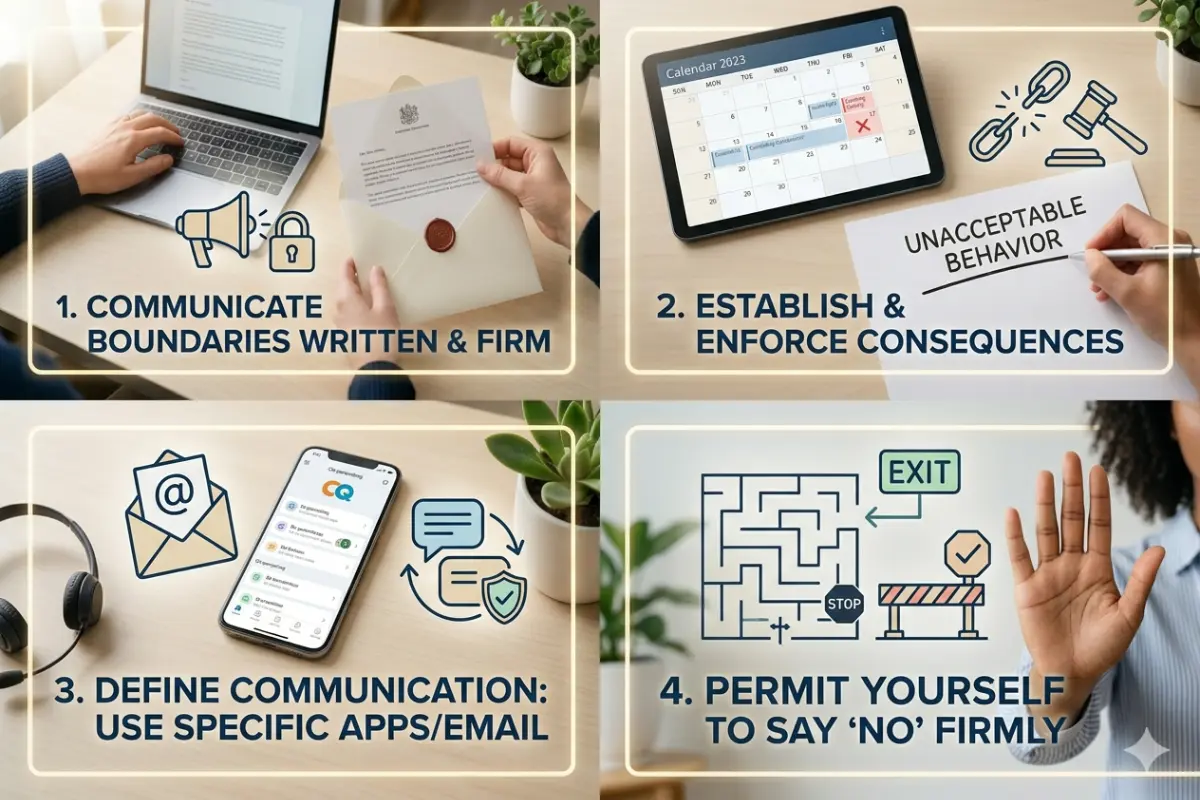
Figuring out what your boundaries are can be a process. However, as you consider what is right for your situation, you should also consider strategies for maintaining them.
These 4 tips will help you keep your boundaries strong and steady as you move toward a resolution in your divorce and afterward.
1. Make your boundaries (clearly and firmly) known
You can have the most well-thought-out boundaries in the world, but if no one knows what they are, they won’t be effective. That’s why the first step in setting boundaries during your divorce is clearly communicating them to your soon-to-be ex.
For example, if child support payments have been a source of conflict in your divorce, clearly state the parameters of your boundaries. This might look like:
- Avoiding discussion about child support in front of your children
- Setting specific times for child support conversations
- Defining what aspects of child support you’re willing to discuss
- Define how you intend to communicate (discussed further below)
How do you communicate these boundaries?
In situations where amicable conversation is possible, you can meet with your former partner to discuss your boundaries. In high-conflict situations, though, this might feel less than comfortable. It may help to enlist other professionals to communicate your boundaries, such as therapists who specialize in divorce processes or mediators.
Remember that all relationships have boundaries, not just romantic ones. Relationships with your parents, friends, co-workers, neighbors, and even people you’ve just met need boundaries to maintain respect, autonomy, and well-being.
During your divorce, you may find it necessary to set boundaries not just with your former partner but also with other people in your life. For example, you might share the intimate details of why you’re getting a divorce with your best friend but decline to discuss it with your co-workers.
2. Establish and enforce consequences
There’s no one “right” boundary to put into place—the most important thing is that they work for you. But for any boundary to be effective, it needs to come with clear consequences. Otherwise, they can easily be ignored or overlooked.
Take the child support example again. If your ex repeatedly brings up child support payments in front of your children or grills you on spending habits, you might establish consequences like limiting communication about the issue to email. If the problem persists, you could consider modifying your child custody to include provisions that address allowed topics of conversation or to limit parenting time exchanges so that there are fewer face-to-face opportunities for your ex to engage in these discussions.
Your attorney can help you explore the options for your specific situation. With your personal goals and boundaries in mind, they can help you decide whether solutions like mediation or counseling are reasonable, or if stronger legal measures might be necessary.
3. Define how you’re going to communicate
A high-conflict divorce can spill out of the mediation table room (if that’s even appropriate in your case) or out of the courtroom and into other areas of your life. You may find yourself getting caught up in an argument during passing interactions, and even friends and family can find themselves acting as go-betweens.
These patterns are counterproductive to resolving your divorce and can be harmful to others, particularly to children who can be impacted by ongoing parental conflict.
Defining how you’re going to communicate, though, can mitigate these impacts. Take, again, the example of boundaries around child support conversations. You could establish communication boundaries like:
- Limiting topics of conversation, e.g., only discussing issues related to predefined child expenses
- Setting clear expectations, e.g., no name-calling or personal attacks
- Acceptable response times, e.g., responses to non-emergency questions, will be made within 48 hours
- Frequency of communication, e.g., weekly or monthly check-ins on child support questions
- Method of communication, e.g., emails, texts, or co-parenting apps
4. Permit yourself to say no
Permit yourself to say no to your soon-to-be ex. “No” is a full sentence and can be a very healthy part of maintaining your boundaries. It might apply to just some aspects of your divorce, such as if you’re not comfortable with having face-to-face mediation sessions because of ongoing disputes over who gets the marital home.
Your boundaries can also include saying “no” to friends and family who want you to attend an event that your ex is also attending or want you to “just talk to them one more time” about an issue.
If you struggle with saying “no,” a high-conflict divorce attorney can support you and advocate for your needs during the divorce process, both in negotiations and in providing techniques to protect your boundaries. They can also explain to you when and how to use “No” when responding to or communicating with your ex, especially when issues of custody and parenting time are ongoing.
What Is Parallel Parenting and How Does It Reduce Conflict?
Parallel parenting is a co-parenting approach where both parents raise their child independently, with minimal direct contact or communication between them. Instead of cooperating closely on every decision, each parent takes full responsibility during their own parenting time. This approach significantly reduces the daily friction that fuels high-conflict situations.
Traditional co-parenting works well when both parents can communicate respectfully and put their differences aside. In high-conflict divorces, though, that level of cooperation is often not realistic, at least not in the early stages. Every handoff becomes a flashpoint. Every text message becomes a battle. Parallel parenting removes that exposure by keeping contact to an absolute minimum.
Here is how parallel parenting works in practice:
- Each parent makes day-to-day decisions independently during their own parenting time, without consulting or negotiating with the other parent on routine matters like bedtime, meals, or weekend activities.
- Major decisions (medical, educational, religious) are handled through written communication only, typically email or a dedicated co-parenting app that keeps a clear record of all exchanges.
- Handoffs are structured to avoid direct interaction. School drop-offs and pick-ups replace direct exchanges. A neutral third party can facilitate transitions if necessary.
- Parenting plans are detailed and specific, covering holidays, school events, and schedule changes in advance, so there is less room for disagreement in the moment.
Research consistently shows that ongoing parental conflict harms children’s
emotional development more than the structure of the parenting arrangement itself. Parallel parenting protects children from that conflict by keeping them out of the crossfire while still maintaining a relationship with both parents.
Parallel parenting is not a permanent state. Many families start with a strict parallel parenting structure and gradually move toward more cooperative co-parenting as conflict reduces over time, as children grow older, and as both parents establish their new lives. Think of it as a boundary-in-itself: a structure that protects everyone while the emotional intensity of the divorce begins to settle.
Your attorney can help you formalise a parallel parenting arrangement in your custody agreement, including specific language around communication methods, decision-making protocols, and handoff procedures. Having these terms in writing gives you legal backing if the arrangement is not respected.
Boundaries, legal strategy, and what comes next
During a high-conflict divorce, boundaries and legal strategy are closely intertwined, allowing you to make decisions on rational considerations rather than emotional responses.
But while legal questions might be at the forefront of your mind right now, learning how to set effective boundaries is something that will serve you long after you’ve arrived at your “post-divorce” destination. Your boundaries will help you navigate co-parenting, build healthy relationships with the important people in your life, and feel confident in your ability to advocate for yourself.
Frequently Asked Questions
What is the first step to setting boundaries with a high-conflict ex?
The first step is identifying your personal triggers and deciding which topics are no longer up for verbal discussion. You should then communicate these rules in writing to ensure there is a clear record. This prevents the “he-said, she-said” dynamic that fuels most high-conflict cases.
Can a judge enforce my personal boundaries in court?
A judge can include specific communication rules in your final court order or parenting plan. For example, the court can mandate the use of a co-parenting app like OurFamilyWizard to monitor all messages. Court-ordered communication apps are often used to reduce harassment.
How do I handle an ex who ignores every boundary I set?
When an ex ignores boundaries, you must move toward “disengagement” by stopping all non-essential responses. If the behavior is harassing or violates a court order, you should document every instance. Share these logs with your attorney to determine if legal sanctions are necessary.
Is it healthy to stop talking to my ex entirely during divorce?
If there is a history of abuse or extreme hostility, “no contact” or “low contact” is often the healthiest choice. You can route all necessary information through your legal counsel or a third-party app. This physical and emotional distance is often vital for healing.
What should I do if my family doesn’t respect my divorce boundaries?
Explain clearly to your family that you will not discuss the details of the case or your ex during gatherings. If they continue to push, you may need to limit your time with them temporarily. Protecting your mental health is more important than satisfying their curiosity.
About The Author:
Alison Lurie is a farmer of words in the field of creativity. She is an experienced independent content writer with a demonstrated history of working in the writing and editing industry. She is a multi-niche content chef who loves cooking new things.