
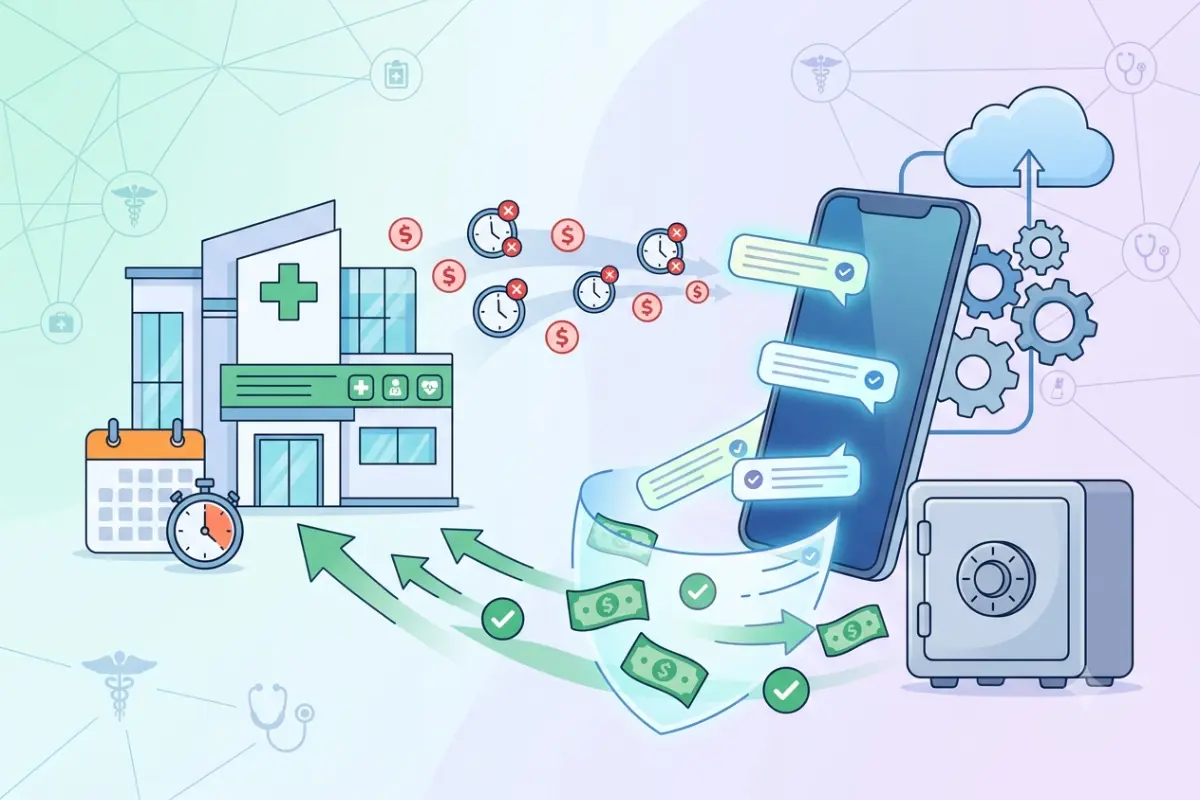
TL;DR: Missed appointments cost the average private practice $200 per empty slot and up to $150,000 a year in lost revenue. Automated SMS reminders reduce no-show rates by up to 38%, run without ongoing staff effort, and cost far less than the revenue they protect. This post explains the real cost of no-shows, why text outperforms calls and postcards, and how to set up a reminder system that actually works.
Automated SMS reminders for private practice revenue protection are among the most straightforward fixes available to any healthcare office, yet one of the most consistently overlooked. The average missed appointment costs a practice around $200 in lost revenue and wasted physician time. Multiply that by a no-show rate of 23%, the national average across US outpatient practices, and you’re looking at a real, recurring financial leak that quietly compounds every single month.
What’s surprising is how fixable this is. Most no-shows happen for simple reasons: the patient forgot, something came up, or they couldn’t figure out how to reschedule quickly enough to bother. A well-timed text changes the outcome for a large share of those cases. It doesn’t require a new hire, a software overhaul, or a long implementation process. It requires a clear-eyed look at how much the gap is actually costing you and a basic system to close it.
This post walks through the real numbers, what traditional reminder methods get wrong, and what a modern SMS reminder setup actually looks like in practice.
What Does a No-Show Actually Cost a Private Practice?
A single missed appointment costs a private practice an average of $200, but that figure understates the real damage. The slot cannot be sold again. The staff has already prepared for it. And the cumulative loss across a week, a month, and a year is the number that should get practice owners’ attention.
For a single provider seeing 20 patients a day, a 7% no-show rate works out to roughly $46,000 to $83,000 in lost annual revenue depending on the specialty. A 5-provider orthopaedic group at a similar rate is looking at around $418,000 per year in missed revenue before accounting for the rework. These aren’t opportunity costs. The overhead fired anyway. The staff was there. The room was prepped.
The indirect costs make it worse. Front desk staff spend an average of 6 to 8 minutes trying to reach a patient after a no-show, then another 10 to 15 minutes trying to fill the slot from a callback list. At $25 per hour, that’s $6 to $10 of pure labor cost per missed visit, on top of the empty slot itself.
There’s a downstream retention risk too. Patients with even a single no-show show an attrition rate of nearly 70%, compared to 19% for patients who always show up. One missed appointment can mark the beginning of a lost patient relationship, not just a lost hour.
The loss shows up as empty calendar slots rather than a single visible line item. That’s exactly why it doesn’t get the attention it deserves until someone actually runs the numbers for a full quarter.
Why Phone Calls and Postcards No Longer Get the Job Done
Phone calls and postcards were designed for a different era of patient behavior. They’re not failing because practices are using them badly. They’re failing because the environment they were built for no longer exists.
68% of consumers now text more than they talk on their smartphones. Three out of ten people say they would give up phone calls entirely in favor of texting. When a practice calls to confirm an appointment, that call goes to voicemail a significant percentage of the time, and voicemails are rarely returned. When a postcard arrives weeks in advance, it lands before the patient has any reason to think about the appointment, and it gets buried or discarded before it becomes useful.
Both methods also consume staff time that could be spent elsewhere. A front desk employee placing reminder calls for 30 minutes each morning isn’t available to handle incoming calls, process paperwork, or help patients in the office during that time. The labor cost compounds the ineffectiveness.
Studies show no-show rates remain at 15% to 30% when practices rely on traditional manual reminders. That’s not a marginal failure. It means roughly one in four or five patients isn’t showing up even when a staff member tries to reach them. The effort isn’t translating into attendance, and the lost revenue is accumulating either way.
How Do Automated SMS Reminders Actually Reduce No-Shows?
Automated SMS reminders reduce no-show rates by reaching patients immediately through the channel they already use, without requiring any login, app download, or effort on their part. Research consistently shows SMS reminders reduce missed appointments by 26% to 38%, and the system runs continuously once it’s set up.
Text messages get read. SMS has a 98% open rate, compared to roughly 26% for email. A phone call goes to voicemail. A text arrives on the lock screen and is seen within minutes. 84% of patients say they’re more likely to attend an appointment if they receive a text reminder, and appointment attendance increases by 67% when providers use SMS to connect with patients.
The effectiveness shows up in real practice data too. Adelante Healthcare reduced its no-show rate by an average of 35%, bringing it from 18 to 20% down to 13% for specialist treatment. Health PEI’s obstetrics clinic saw a 69% decrease in no-shows through consistent reminders. Jackson-Hinds Community Health Center cut its no-show rate from 33% to 26% across 209,131 scheduled visits, preserving nearly $1 million in visit revenue without adding staff.
What makes SMS work where other methods don’t is the lack of friction. There’s nothing to download, no portal to log into, no call to return. The patient reads the message, taps a reply, and it’s done. That simplicity is what drives the response rate. Practices that adopt mobile messaging solutions for appointment reminders typically see patients confirm, reschedule, or cancel well in advance, giving front desk staff time to fill the resulting opening rather than discovering an empty chair at the scheduled time.
What Makes a Reminder System Work Beyond the First Message?
A single reminder sent a few days in advance is better than nothing. But the practices that see the strongest results use a layered sequence: an initial reminder several days out, a confirmation request the evening before, and a quick day-of check-in for patients who haven’t responded.
Each layer captures a different type of patient. The advance reminder catches those who have simply forgotten and who can reschedule before the slot is a problem. The night-before message catches the patient who genuinely planned to come but just ran into a conflict. The day-of message reaches the small group who didn’t respond to anything earlier. A 2025 review found no-show rates dropped 25 to 40% when practices combined automated reminders with pre-visit digital engagement, compared to single-reminder approaches.
The two-way reply option matters just as much as the timing. 68% of patients want two-way texting where they can confirm or reschedule directly from the message. When a patient who can’t make it can reschedule in seconds instead of just not showing, the slot opens back up with enough time to fill. That single feature turns a would-be no-show into a rescheduled appointment and an open slot for another patient.
When I looked at the practices that were getting the biggest reductions, the common thread wasn’t a particular platform. It was consistent. They had a sequence, they ran it for every patient, and they didn’t rely on staff to manually trigger any part of it.
Is Automated SMS Messaging HIPAA-Compliant for Healthcare Practices?
Yes, automated SMS reminders can be HIPAA-compliant, but only when the platform you use is designed specifically for healthcare and includes a signed Business Associate Agreement (BAA). A standard consumer texting tool does not meet the standard. A purpose-built healthcare messaging platform does.
The distinction matters because HIPAA requires that any platform handling patient information agree contractually to protect it. A BAA is the required agreement between a healthcare provider and any vendor who handles protected health information (PHI). Most healthcare-specific messaging platforms include this as part of onboarding. If a vendor can’t produce one, that’s a dealbreaker regardless of everything else they offer.
In practice, compliant SMS reminders typically include the appointment date and time but avoid including specific diagnosis information, treatment details, or anything that would identify the medical reason for the visit in the message body. The confirmation happens through a simple reply to the text. Sensitive clinical information stays in the secure patient record, not the reminder itself.
Over 70% of physician practices already use some form of text messaging to communicate with patients, and HIPAA-compliant options are widely available at price points that make sense for practices of any size.
How Do You Calculate the Return on an SMS Reminder System?
You don’t need a financial model to calculate whether this makes sense. You need three numbers you already have: your monthly scheduled appointment volume, your current no-show rate, and your average revenue per visit.
Multiply them together, and you get your monthly revenue at risk. A practice with 2 no-shows per day at $100 per visit loses over $50,000 per year. A practice with 5 no-shows per day at $200 per visit is over $250,000. Most automated reminder platforms cost $100 to $300 per month. The math is straightforward: even recovering 20 to 30% of your current no-shows puts the system into profit within the first billing cycle.
The labor savings add to that. Automated systems cost around $1 to $5 per outreach via text, compared to $16 per manual phone call. For a practice sending 400 reminders a month, switching from phone calls to automated texts saves $4,400 to $5,600 in staff labor per month, before you count a single recovered appointment.
The combined impact, recovered revenue plus labor savings, makes automated SMS one of the few practice improvements where the return is visible within 60 to 90 days rather than over a year.
Conclusion
Protecting private practice revenue doesn’t always mean seeing more patients or raising prices. Sometimes it just means making sure the patients already on the schedule actually show up.
Three things stand out from the evidence here. First, the financial impact of no-shows is larger than most practice owners realize because the losses are distributed across many small gaps rather than one visible line item.
Second, SMS reaches patients where they already are, at a 98% open rate, without requiring any effort from them. Third, the return on a well-configured reminder system is measurable within the first few months, and the system runs on its own after that.
If you haven’t calculated your current no-show cost, that’s the right starting point. Once you have the number, the decision about what to do next tends to become straightforward.
Frequently Asked Questions
How Much Do No-shows Cost a Private Medical Practice Each Year?
The average missed appointment costs around $200 in lost revenue and physician time, according to Veterans Health Administration analysis and multiple industry studies. A single provider with a 7% no-show rate can lose $46,000 to $83,000 annually, depending on specialty. For a 5-provider practice, that figure can exceed $400,000 per year before accounting for staff time spent trying to fill empty slots.
How Much Can Automated SMS Reminders Reduce No-show Rates?
Research shows SMS appointment reminders reduce no-show rates by 26% to 38%, with some healthcare systems reporting reductions of up to 69% using consistent automated reminder sequences. A systematic review of 29 studies found the median no-show rate dropped from 23% to 13% after reminder system implementation, with 97% of studies showing meaningful improvement in attendance.
Are Automated SMS Reminder Platforms HIPAA-compliant?
Yes, if you choose a platform built specifically for healthcare. The platform must provide a signed Business Associate Agreement (BAA), which is a required contract under HIPAA between the healthcare provider and any vendor handling protected health information. Standard consumer texting apps do not meet this requirement. Most healthcare-specific messaging platforms include the BAA as part of their onboarding process and limit message content to appointment logistics rather than clinical details.
Why Do Patients Prefer Text Reminders Over Phone Calls?
SMS messages carry a 98% open rate, compared to 26% for email, and most people now text more than they talk on their phones. 84% of patients say they’re more likely to attend an appointment after receiving a text reminder, and patients can confirm, cancel, or reschedule directly from the message without calling the office. That low-friction experience is why response rates for SMS far exceed those for calls or voicemail.
How Many Reminders Should a Practice Send Before Each Appointment?
A three-message sequence produces the strongest results: one reminder 72 hours in advance, a confirmation request the evening before, and a brief check-in on the morning of the appointment. A 2025 review found no-show rates dropped 25 to 40% when practices used layered reminder sequences compared to single-message approaches. Each message in the sequence captures a different patient: the one who forgot, the one who had a last-minute conflict, and the one who hadn’t responded to either.
About the Author:
 Hassan Mansoor is the Founder and Director of Technical Minds Web, where he specializes in scaling startups through high-impact digital marketing and strategic project management. With an extensive background in SEO and business development, Hassan has a proven track record of executing growth-focused campaigns that bridge the gap between technical execution and brand visibility. A regular contributor to CustomerThink.com, he writes extensively on entrepreneurship, staff productivity, and the evolving landscape of digital growth. Connect with Hassan on LinkedIn to discuss the future of marketing and business scaling.