

TL;DR: Choosing memory care for a loved one is one of the hardest decisions a family will face, but today’s options are better than ever. From purpose-built memory care communities to in-home support and adult day programs, each approach offers something different depending on your loved one’s stage of decline, daily needs, and living preferences. This guide covers all five modern options clearly so you can make a confident, informed choice.
Choosing the right care for someone experiencing memory loss ranks among the most emotionally challenging decisions any family will face. The good news? Our understanding of dementia and Alzheimer’s disease has grown tremendously, and the care options available today reflect that progress. An estimated 7.2 million Americans aged 65 and older are now living with Alzheimer’s dementia, and that number is expected to nearly double by 2060. Families are navigating this more than ever before.
Modern memory care facilities embrace innovative approaches that put dignity, safety, and quality of life front and center while delivering the specialized support people with cognitive decline truly need. Getting familiar with what’s out there can empower families to make choices that genuinely fit their loved one’s unique situation and personal preferences.
What Is a Dedicated Memory Care Community and Is It Right for Your Loved One?
A dedicated memory care community is a purpose-built residential facility designed specifically for individuals living with Alzheimer’s and other forms of dementia. These communities offer 24-hour supervision, secure environments to prevent wandering, and staff trained exclusively in dementia care. They differ from assisted living by providing a higher level of structured cognitive support around the clock.
Purpose-built memory care communities are designed from the ground up specifically for individuals living with Alzheimer’s and other forms of dementia. These aren’t just modified buildings. They’re thoughtfully crafted environments featuring secure, enclosed spaces that prevent wandering while creating an atmosphere that actually feels like home rather than an institution.
Walk through one of these communities, and you’ll notice details that matter: color-coded hallways that reduce confusion, signage combining words with pictures for easier recognition, and circular walking paths that let residents move freely without hitting frustrating dead ends. According to A Place for Mom, 76% of partner memory care communities are specifically designed to accommodate residents with memory loss, and 78% offer an enclosed courtyard.
Staff members don’t just show up for work. They complete extensive training in dementia care techniques, learning how to redirect behaviors compassionately, communicate effectively when words become difficult, and recognize what each resident needs on any given day. 79% of A Place for Mom’s partner memory care communities provide specialized memory care training for all staff, a standard that genuinely matters when your loved one’s wellbeing depends on daily interactions going well.
Should You Choose a Memory Care Unit Within an Assisted Living Facility?
Memory care units inside assisted living facilities offer the best of both worlds: specialized dementia support in a setting that feels warmer and less clinical than a standalone memory care facility. They’re a smart choice when one spouse needs memory care, but the other doesn’t, because both partners can stay in the same community while receiving different levels of care.
Here’s an option that combines the best of both worlds: many assisted living facilities now include specialized memory care units or neighborhoods tucked within their larger communities. What makes this arrangement appealing? Loved ones receive dedicated dementia care in a setting that often feels less clinical than a standalone memory care facility.
These units usually occupy a separate, secure wing or floor, complete with all the safety modifications and specialized programming memory care residents require. The real advantage shows up in practical ways. Couples can stay in the same community even when only one spouse needs memory care services, making visits easier and keeping important connections intact.
According to data from Inspired Living, memory care typically costs 15 to 25% more than standard assisted living, ranging from around $7,000 to $7,600 per month nationally. But choosing a combined community can sometimes reduce overall costs. One family reported saving nearly $1,000 per month when their mother transitioned from high-level assisted living into the memory care unit within the same building, because her care needs were reclassified at a lower tier.
Can Your Loved One Receive Quality Memory Care at Home?
Yes. In-home memory care services can provide comprehensive dementia support without requiring any relocation. Professional caregivers come directly to the home to help with daily activities, medication management, and cognitive engagement. This option works best for individuals in the early to moderate stages of memory loss who still feel comforted by familiar surroundings.
Not every family wants, or needs, to move their loved one out of the home they’ve known for years. In-home memory care services deliver comprehensive support right where someone feels most comfortable, no relocation required. Professional caregivers arrive at the home to provide supervision, help with daily activities, manage medications, and offer engaging activities tailored to whatever cognitive abilities remain strong.
This option shines particularly bright for individuals in early to moderate stages of memory loss who still recognize their surroundings and draw real comfort from familiar spaces. Staying home can reduce anxiety and disorientation, two significant challenges for individuals with Alzheimer’s, because the environment itself provides a layer of reassurance that even the best facility cannot replicate.
It’s worth planning carefully for how needs may change over time. In-home care that works beautifully in the early stages may need to be supplemented or replaced as cognitive decline progresses. Discussing a transition plan early, before a crisis forces the decision, gives families far more control over the outcome.
Adult Day Programs for Memory Care
Adult day programs specializing in memory care strike a valuable middle ground, providing structured activities, socialization, and professional supervision during daytime hours while participants return home each evening. These programs offer an excellent solution when there’s a caregiver at home who needs respite during working hours or simply requires time to handle life’s other responsibilities without constant worry.
Participants dive into cognitive stimulation activities, physical exercise, music therapy, art projects, and social interaction, all designed specifically for people navigating memory impairment. Transportation often comes included, removing another logistical hurdle for busy families. The structured routine and mental stimulation can genuinely help slow cognitive decline while reducing behavioral issues that crop up from boredom or isolation.
When evaluating specialized options, families searching for memory care in Sugar Land should consider programs that provide valuable support through regular breaks from caregiving duties, reducing burnout and stress. Nearly 59% of dementia caregivers report high to very high emotional stress, according to the Alzheimer’s Association, and adult day programs directly address that by giving the primary caregiver a structured break.
Most programs bundle meals and snacks into their services, and some have developed specialized tracks for specific types of dementia or different stages of decline. This arrangement lets individuals maintain residence in their own homes while getting professional care and engagement when they need it most.
What Makes Small Group Homes Different From Larger Memory Care Facilities?
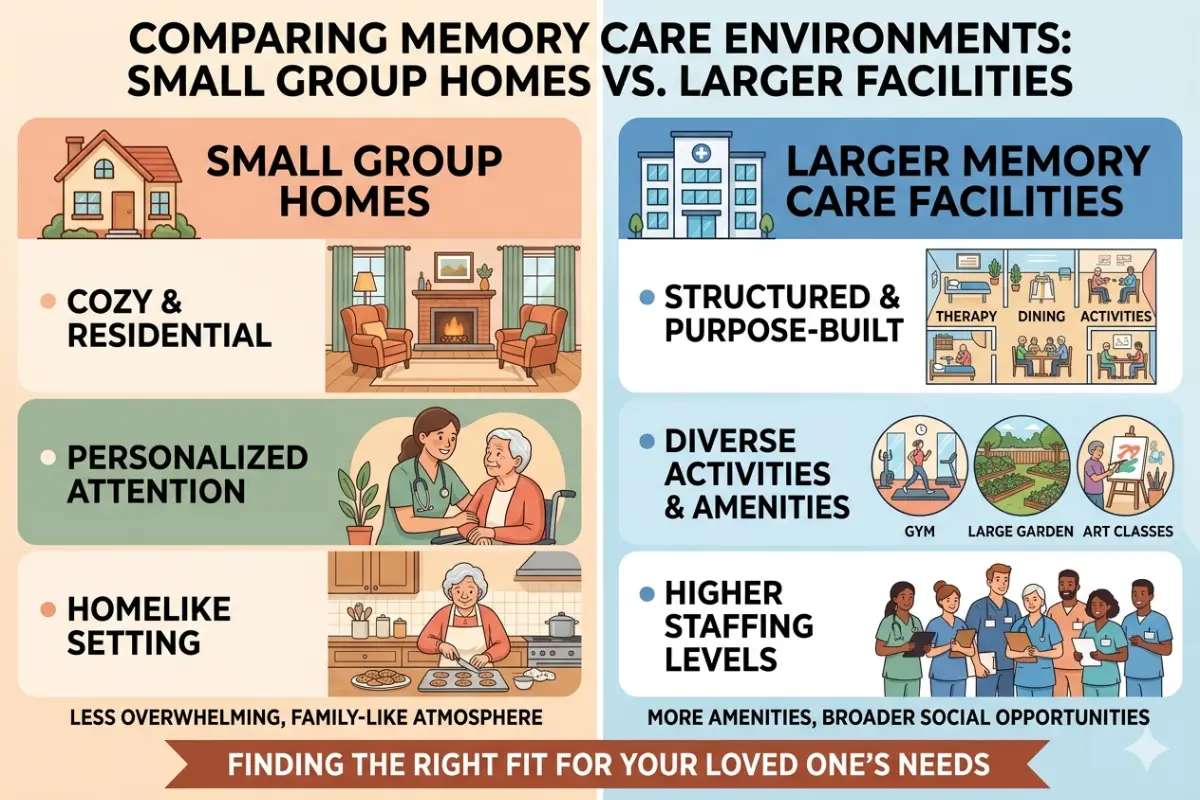
Small group homes deliver memory care in an intimate, family-style setting for 6 to 10 residents, rather than the larger populations typical of mainstream facilities. Residents receive 24-hour supervision and specialized dementia care, but in an environment that genuinely feels like a home rather than an institution. Personalized attention is not a goal here; it’s the natural result of the small scale.
Small group homes, sometimes called residential care homes or board-and-care homes, deliver memory care in an intimate, family-style setting, typically housing just six to ten residents. What you won’t find here is the institutional feel of larger facilities, yet residents still receive 24-hour supervision and specialized dementia care from trained professionals.
The smaller scale makes highly personalized care plans not just possible but practically inevitable, and relationships between caregivers and residents often grow genuinely strong. Daily life in these homes mirrors what you’d experience in a traditional household, with shared meals around an actual table, small-group activities that everyone can participate in, and individual attention that’s nearly impossible to replicate in larger settings.
These homes often carry lower price tags than larger memory care communities, making them an attractive option for families working within a tighter budget. The trade-off can be less access to on-site medical resources or specialized programming, so asking detailed questions about staff credentials and emergency protocols is especially important when evaluating this option.
Conclusion
Selecting the right memory care option demands careful thought about where your loved one is right now, how their condition might progress, what your family can realistically manage, and what financial resources you’re working with. Each of these five modern approaches brings distinct advantages to the table, and there’s honestly no one-size-fits-all answer. The best choice flows from individual circumstances.
Many families discover that their loved one’s needs shift over time, sometimes requiring transitions between different care levels or approaches as the journey continues. Visiting multiple facilities in person, asking pointed questions about staff training and daily programming, and trusting your gut about the environment and care quality matter enormously in this deeply important decision.
You don’t have to figure this out alone. The Alzheimer’s Association helpline offers free, confidential support in more than 200 languages and can help you navigate local care options specific to your situation.
Frequently Asked Questions
What is the difference between memory care and assisted living?
Memory care is a higher level of care specifically designed for people living with Alzheimer’s disease or other forms of dementia. Assisted living supports seniors who need help with daily tasks but can otherwise live relatively independently. Memory care typically costs 15 to 25% more than standard assisted living because it requires specialized staff, secure environments, and dementia-focused programming that standard assisted living does not provide. The right choice depends on the individual’s current cognitive stage and safety needs.
How much does memory care cost in the United States?
Memory care costs vary significantly by state, ranging from approximately $4,800 to $11,200 per month nationally, with a median cost increase of 3.7% from 2024 to 2025. Location, facility type, room configuration, and the level of care required all influence the final price. Some families offset costs through long-term care insurance, Medicaid waivers (where available), or Veterans Administration benefits. Planning early gives families more options and reduces financial pressure when the time comes to make a transition.
Can a person with dementia stay at home rather than move to a facility?
Yes, many people with dementia remain at home, particularly in the early to moderate stages. In-home memory care services bring professional caregivers to the home to provide supervision, medication management, and cognitive engagement activities. This option works best when the individual still recognizes their surroundings and when a family caregiver or professional aide is available to supplement support. As the condition progresses, in-home care often needs to be supplemented with other options like adult day programs or a gradual transition to residential care.
What questions should I ask when touring a memory care facility?
The most important questions to ask cover staffing ratios, staff training credentials, daily programming, how the facility handles behavioural changes, and what the process looks like for transitioning residents to a higher level of care if needed. 79% of A Place for Mom’s partner memory care communities provide specialized memory care training for all staff, but verifying this directly during a tour is essential. Also, ask about how they communicate with families and how care plans are reviewed and updated as a resident’s needs change.
What is an adult day program for memory care, and who benefits most?
An adult day program for memory care provides structured daytime activities, professional supervision, and social engagement for people living with dementia, while they return home each evening. They benefit people in the early to moderate stages of memory loss who are still living at home, and are especially valuable for families where a caregiver needs daily respite. The Alzheimer’s Association reports that 59% of dementia caregivers experience high to very high emotional stress, and adult day programs directly address this by providing a structured, professional break for the primary caregiver.
About The Author:
Robert W. Bache (aka “Medicare Bob”) is the founder and Chief of Sales for Senior Healthcare Direct, an AmeriLife company. As an independent insurance broker, Bache and his team provide unbiased assistance to current and soon-to-be Medicare beneficiaries, helping them navigate, compare, and find the right Medicare plan options. Bache’s agency, Senior Healthcare Direct, works with 30-plus companies and has served tens of thousands of clients in more than 40 states.
Disclaimer: This post is for informational purposes only and is not a substitute for professional medical advice, diagnosis, or treatment. If you are experiencing severe stress, mental health difficulties, or thoughts of self-harm, please seek support from a qualified healthcare professional.