
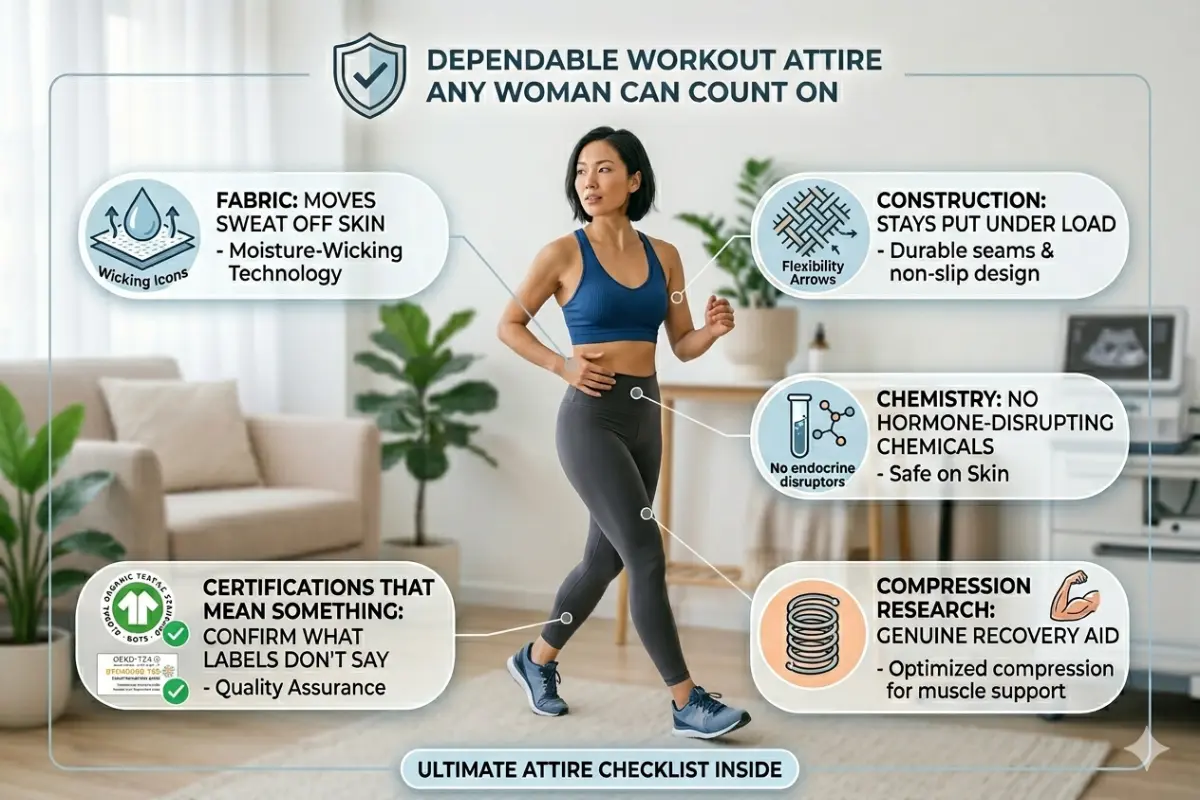
As someone who has yanked a waistband back up mid-deadlift and finished a HIIT class in see-through leggings, I know that the wrong workout attire splits your focus when you need it most. Truly dependable activewear isn’t just about looks; it requires fabric that moves sweat, construction that stays put under load, and third-party safety certifications. While premium compression leggings aid muscle recovery, many popular blends contain hidden, hormone-disrupting chemicals. This guide exposes misleading activewear marketing and gives you an un-gameable blueprint for your next purchase.
What Makes Workout Attire Any Woman Can Count On?
Dependable workout attire does three things: it stays in place during movement, manages sweat and heat for your specific effort level, and carries verified safety certifications. It removes friction instead of adding it. When clothing disappears into the background of a session, that’s the goal achieved.
That definition sounds simple. In practice, it’s why most activewear falls short. Clothing that fits in the changing room behaves differently under load. Fabric that feels soft on the rack can trap heat and odor after twenty minutes of cardio. And the confidence that comes from gear you trust is real: research on enclothed cognition shows that up to 96% of study participants experienced measurable emotional state changes based on their clothing choices. What you wear before a workout affects how you show up for it.
Putting on workout attire that actually performs is a mental cue. It tells your brain it’s time to move. Wearing clothes associated with a specific role primes you for that role’s demands. That’s not a small thing for consistency.
Does “Breathable” Actually Mean Anything on a Clothing Label?
“Breathable” is a marketing word with no regulated definition in activewear. A fabric can pass air through it and still trap heat, hold odor, and cause skin irritation during intense exercise. What determines real temperature regulation is fiber type, weave structure, and whether the fabric moves sweat off your skin before it sits there and causes problems.
Here’s what the label should actually tell you.
The Activewear Textile Selection Framework
Use this three-tier material framework to match your clothing fabrics to your specific workout environment and sweat output:
- Choose Polyester-Spandex Blends for Hot, Humid Environments: Polyester dries 10% to 30% faster than nylon and holds its shape much better when wet. Because it dries so rapidly, it leaves less time for odor-causing bacteria to multiply on the garment.
- Choose Nylon-Spandex Blends for High-Friction and Strength Sessions: Nylon features a much softer, smoother feel against the skin and offers superior abrasion resistance against gym equipment. A blend of 78% nylon and 22% spandex provides the best stretch recovery for form-fitting leggings.
- Choose Merino Wool Blends for Variable Temperatures and Outdoor Training: Merino wool naturally regulates your body temperature and possesses built-in antimicrobial properties. While it dries slower than synthetics, it prevents odor without using chemical coatings.
Weave structure matters more than the hangtag: An open-knit mesh panel in a high-sweat area (behind the knee, under the arm) does more for temperature regulation than a tight polyester weave labeled “breathable” on the tag. Look for ventilation where your body actually generates heat, not just where it photographs well.
If you’re also thinking about choosing the right pre-workout to match your session intensity, the fabric you’re wearing should match that same logic. High-intensity effort needs different fabric behavior than a recovery walk.
Are Synthetic Workout Leggings Safe to Wear for High-Intensity Exercise?
Synthetic workout leggings can pose safety risks because recent chemical research detects endocrine disruptors like BPA and PFAS in popular activewear brands. During heavy exercise, rising body heat and sweat act as solvents, increasing your skin’s chemical absorption rate up to 3,252 times compared to dry contact.
Most women buying leggings aren’t thinking about chemical exposure. That gap has benefited the activewear industry for years.
BPA in activewear: A major list of popular brands faced legal notices for BPA exposure, including Athleta, PINK, The North Face, Nike, Reebok, and others. BPA is an endocrine disruptor that mimics estrogen in the body. It’s especially concerning during workouts because as body temperature rises, pores dilate and sweat acts as a solvent that dissolves chemical residues from fabric. Studies on bisphenols show significantly higher transfer under warm, sweat-wet conditions, exactly the conditions of exercise. The groin, abdomen, and underarms are among the most absorbent areas of the body, and they’re exactly where form-fitting leggings press hardest.
PFAS in activewear: A 2023 study published in Environmental Science and Technology found that synthetic clothes can release PFAS through microplastics deposited on the skin via sweat. A 2025 study using dermal transfer modeling found that sweat can increase chemical absorption up to 3,252 times compared to dry fabric contact. Both New York and California banned clothing containing PFAS starting January 2025, and the regulatory momentum is global. In April 2026, the Texas Attorney General issued a civil investigative demand to Lululemon examining whether its marketing was consistent with its actual chemical content. Self-reported phase-outs are difficult to verify without third-party testing data.
What actually protects you:
OEKO-TEX Standard 100 uses stricter chemical limits for items worn close to the body, like activewear. The more skin contact, heat, and sweat involved, the stricter the testing thresholds. GOTS certification covers the full organic supply chain. Bluesign covers responsible chemical use in manufacturing. Every OEKO-TEX certified product carries a certificate number you can verify through the OEKO-TEX Label Check database.
Practical steps that actually reduce exposure: look for these certifications on the label before buying. Wash new synthetic activewear before wearing it. Change out of workout clothes instead of wearing them for hours afterward. These aren’t dramatic changes. They’re small decisions that compound.
Understanding what goes against your skin during a sweat session matters just as much as keeping your skin healthy and radiant after the workout is done.
How to Choose Reliable Workout Leggings That Actually Stay Put
Reliable leggings need four things: four-way stretch fabric, a structured waistband with bonded or reinforced edges, squat-proof opacity under bright light, and flatlock seams at high-friction points. That combination removes every common failure mode.
Here’s how to check each one before buying:
Four-way stretch: The fabric should stretch both horizontally and vertically without resistance. Pull it in both directions in the store. If it resists in one direction, it’ll bind during compound movements.
Waistband construction: A wide waistband means nothing if the fabric is flimsy. Look for structured waistbands with bonded or reinforced edges. These hold their shape through repeated washing and don’t roll during squats or forward folds. A flimsy fabric with a wide waistband rolls just as easily as a narrow one.
Squat-proof opacity: Crouch in bright light, ideally in the fitting room or near a window. Check in a mirror. This test catches leggings that look opaque on the rack but aren’t in practice. For strength training specifically, this matters more than any other feature.
Flatlock seams: Standard seams create a raised ridge where two pieces of fabric overlap. Flatlock seams stitch fabric pieces flat against each other, eliminating that ridge. They reduce chafing during longer sessions and hold up far better through repeated washing. This is worth checking the inside of the leggings for, not just the outside.
For home workout routines, the same standards apply as in the gym. Leggings that stay put matter just as much when you’re in your living room as when you’re in a studio.
Does Athletic Compression Gear Genuinely Improve Your Workout Recovery?
Yes, athletic compression gear genuinely improves post-exercise recovery by physically enhancing blood flow and venous return. Clinical studies confirm that wearing graduated compression garments for four hours after resistance training drastically reduces muscle soreness and speeds up your return to baseline strength.
Here’s the split:
Recovery: strong evidence. Research published in Scientific Reports found that wearing compression tights for four hours after a resistance exercise session improved venous return and blood flow, and ruled out placebo as the explanation. Compression reduces delayed onset muscle soreness (DOMS) and supports faster return to strength between training sessions. The clearest benefits appear for strength training recovery, particularly after sessions with a heavy eccentric component, like squats, deadlifts, or lunges.
Performance during exercise: mixed evidence. Some studies show reduced muscle oscillation and better joint stability during activity. Others show no significant performance difference. If you’re wearing compression leggings expecting to run faster or lift more in the moment, the research doesn’t support that at the same level. Bottom wear plays a major role in overall workout comfort. High-quality options like workout leggings for women provide support, flexibility, and durability.
What graduated compression means: Pressure is highest at the ankle and decreases up the leg. This design supports the circulatory direction the body needs most. Generic “compression” leggings with uniform pressure throughout don’t provide the same circulatory benefit. High-waist compression panels can help stabilize the core during movement, but their value depends on the fabric’s actual compression level, not just the panel width.
Not everyone should use high-compression garments. Women with certain circulatory conditions or skin sensitivities should check with a physician before wearing high-compression activewear regularly.
What to Wear for Each Type of Workout
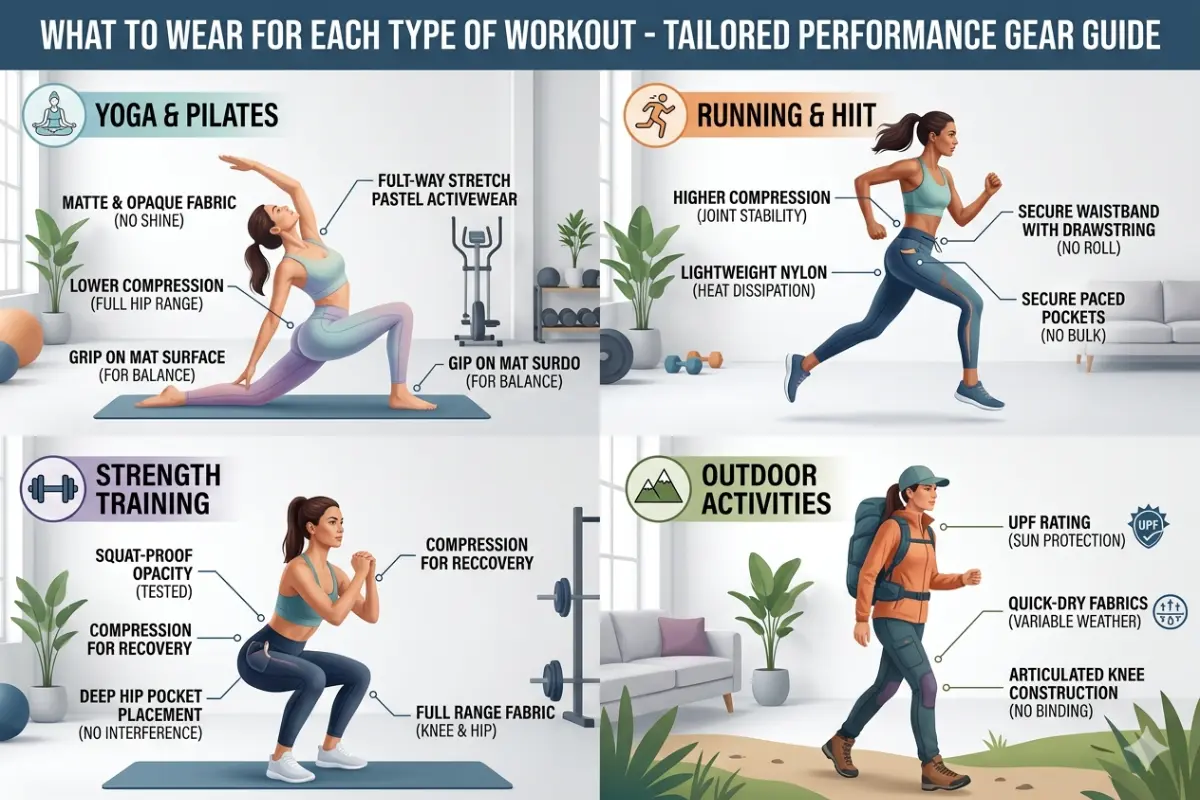
Different workouts genuinely need different things. Using the same pair of leggings for yoga and HIIT is convenient. It’s also often the reason something fails.
Yoga and Pilates: Prioritize four-way stretch and fabrics that move with the body without resisting. Lower compression allows fuller hip and hip-flexor range. Matte, opaque fabric is important here: shiny or ribbed textures reveal movement in ways that create self-consciousness during poses. If your practice includes balancing work, fabric that creates some grip on a mat surface helps more than slick nylon.
Running and HIIT: Higher compression supports joint stability and manages sweat volume at higher heart rates. Lightweight nylon-based fabrics outperform heavier polyester blends in heat dissipation during sustained cardio. A secure waistband with an internal drawstring prevents rolling at higher impact. If you run outdoors, reflective details matter at low light. Pockets need to be secure at pace, not just when standing still.
Strength training: This is where compression earns its keep most clearly, particularly for recovery. Squat-proof opacity testing is non-negotiable. Deep hip pocket placement matters: bulk at the hip crease interferes with the bottom position of squats and deadlifts. Fabric needs to move with you through the full range without restriction at the knee or hip.
Outdoor activities: Add UPF rating for sun protection on exposed areas. Quick-dry fabrics handle sweat and variable weather better than anything marketed primarily on softness. Articulated knee construction, where the fabric is cut with a slight forward angle at the knee, prevents binding during climbing, cycling, or hiking without restricting movement elsewhere.
The Myths That Cost Women Money and Performance
Myth: The more expensive, the better.
Reality: Price has no reliable correlation with fabric safety or performance. Several premium brands appeared in the BPA testing results. Several affordable brands carry OEKO-TEX certification. Look for certifications over price tags.
Myth: Cotton is always bad for workouts.
Reality: Cotton absorbs moisture but doesn’t wick it away. For low-intensity activity, walks, or yoga in a cool room, cotton is fine. For high-intensity work with heavy sweating, it stays wet against your skin, gets heavy, and increases friction. Context determines whether it works.
Myth: Compression leggings help you lose weight.
Reality: They don’t. Compression reduces swelling and supports circulatory recovery. It doesn’t change body composition. Products marketed as “slimming” compression are selling an aesthetic claim, not a physiological one.
Myth: Seamless always means comfortable.
Reality: Seamless construction removes seam-related chafing. But if the underlying fabric is low-quality, thin, or chemically treated, seamless construction doesn’t fix those problems. Check fabric quality and certifications independently of construction claims.
Myth: A high waistband always means more support.
Reality: High-waist panels provide core containment when the fabric has an actual compression level built in. Structured, bonded edges are what create real support, not panel height alone.
Your Next Step: Use the Workout Attire Checklist
Here are the three things that move the needle most:
First, check the fiber content before buying. If it reads “polyester/spandex” and there’s no certification on the label, that’s your signal to look for OEKO-TEX, GOTS, or Bluesign before committing. Second, match the fabric to your actual workout: lower compression and four-way stretch for yoga, higher compression and secure waistbands for running and strength work. Third, use compression leggings as a recovery tool after hard sessions, not just during them.
Reliable gear doesn’t eliminate effort. But it removes the small, compounding distractions that chip away at a consistent routine. Building a workout routine that succeeds starts with removing the things that get in the way. The right workout attire is one of them.
Use the checklist below before your next activewear purchase.
Workout Attire Checklist: Before You Buy
- Does the label show OEKO-TEX, GOTS, or Bluesign certification?
- Is the fiber content nylon-spandex, natural fiber, or, at a minimum, certified polyester-spandex?
- Did I test the squat-proof opacity under bright light?
- Does the waistband have bonded or reinforced edges (not just wide fabric)?
- Does the fabric stretch in all four directions without resistance?
- Are the seams flatlock construction at high-friction points?
- Is the compression level appropriate for my primary workout type?
- Did I plan to wash this before wearing it the first time?
- Am I planning to change out of it promptly after my session?
- Does this actually match the workout I do most?
Frequently Asked Questions
What Fabric is Best for Women’s Workout Leggings?
The answer depends on the workout. Nylon-spandex blends (typically 78% nylon, 22% spandex) offer the best combination of softness, stretch recovery, and skin feel for yoga, Pilates, and strength training. Polyester-spandex blends dry slightly faster and perform well in hot, humid conditions, but retain odor more readily over time. For outdoor or cold-weather activity, merino wool blends regulate temperature passively and resist odor naturally. The most important rule: match the fiber to the effort level and look for OEKO-TEX certification on whichever material you choose.
Are Expensive Workout Leggings Safer or of Better Quality?
No. Price has no reliable correlation with either fabric safety or performance. Testing by the Center for Environmental Health found BPA levels above safe limits in leggings from brands at premium price points. Several affordable brands carry OEKO-TEX or Bluesign certification. The signal worth looking for is a third-party certification, not the price tag or brand name. Always check the label for verified certifications rather than assuming a premium price means safer materials.
How Do I Know If My Leggings Contain BPA or PFAS?
You can’t tell from appearance or feel alone. The best indicators are the fiber content and certifications. Polyester-spandex blends without any certification carry the highest known risk for BPA. PFAS have been detected in multiple synthetic activewear brands through independent third-party testing. To reduce risk: choose leggings with OEKO-TEX Standard 100, GOTS, or Bluesign certification, wash new synthetic activewear before first wear, and change out of workout clothes promptly after exercise rather than wearing them for hours afterward.
How Long Should a Good Pair of Workout Leggings Last?
High-quality leggings with nylon-spandex construction and flatlock seams should last two to five years with regular use and proper care, assuming frequent washing. Signs they’ve reached the end of their life include visible pilling, fabric thinning at friction points (inner thigh, waistband edges), loss of compression, and permanent stretch deformation. Air-drying rather than machine drying extends lifespan significantly, as dryer heat breaks down elastic fibers and accelerates chemical off-gassing from synthetic fabrics.
Is It Okay to Wear Compression Leggings Every Day?
For most women, moderate-compression leggings worn during and shortly after workouts are safe for daily use. High-compression garments, particularly medical-grade or graduated compression, are worth discussing with a physician if you have any circulatory conditions, varicose veins, or skin sensitivities. General-purpose compression leggings designed for athletic recovery are lower pressure and carry no known risk for healthy adults who use them as intended. The key is to let skin breathe between sessions: change out of tight-fitting synthetic activewear after workouts and allow time between compression wear periods.
About The Author:
Beth Shamaiengar is a contributing editor at Health Journal. She holds a Bachelor’s degree in Journalism from the University of North Carolina at Chapel Hill and, before joining the Health Journal, became an award-winning writer and editor during 11 years with other publications. She also spent nearly a decade volunteering in PTA leadership roles in local schools, building her skills in marketing, event planning, project management, and communicating with a variety of audiences.